



內容摘要

2017年,粵港澳大灣區(大灣區)首次被納入《政府工作報告》,提倡推動內地與港澳深化合作,研究制定大灣區城市群發展規劃,發揮港澳獨特優勢,提升在國家經濟發展和對外開放中的地位與功能。自此,大灣區建設正式成為國家級發展戰略。隨著粵港澳的規劃即將出台,大灣區城市群在亞洲地區的角色及功能受到廣泛關注,特別在中國與東盟經貿關係愈見重要的背景下,粵港澳城市群有望透過大灣區建設與東盟十國加強經濟合作,成為亞洲區內兩大增長引擎。


粵港澳大灣區與東盟的經濟概況

從宏觀數據分析,粵港澳大灣區與東盟兩大區域經濟各有不同特色,顯示雙方有廣闊的空間發揮互補優勢。

首先,東盟有龐大的市場規模。2016年,十個成員國GDP總量達到2.56萬億美元,是繼美國、中國、歐盟及日本後的全球第五大經濟體。此外,東盟擁有豐富的天然資源及生產要素,區內面積約450萬平方公里,人口總數高至6.3億人,其中超過一半是30歲以下的年青階層。由於東盟成員國發展步伐不一,區內的人均收入相對不高,2016年整體名義人均GDP約4,000美元,而且其差距亦較大。

至於粵港澳大灣區,整個城市群包括廣東省9個城市(廣州、深圳、東莞、惠州、肇慶、佛山、中山、珠海及江門)及香港和澳門兩個特別行政區。大灣區總面積約5.6萬平方公里,2016年GDP總量1.39萬億美元,人口總數約6,800萬人。大灣區的市場規模相對較東盟為小。

然而,大灣區城市群的經濟發展較為成熟,區內居民一般有較高的收入,2016年名義人均GDP約20,400美元,是東盟的五倍,擁有消費能力較高的中產階層。另一方面,大灣區是中國東南部的主要進出口基地,2016年全區商品貿易總額接近1.9萬億美元,佔其GDP比重達到137%(2016年東盟對外對易總額為2.2萬億美元,佔其GDP比重87%)。因此,大灣區市場有潛質成為東盟商品的主要出口增長點。

值得一提,粵港澳大灣區和東盟過去都有較高的經濟增長。在大灣區城市群中,廣東省9個城市過去五年的實質GDP增長普遍維持在8%水平以上,而香港及澳門兩個特區的經濟發展成熟,其增長相對較慢。整體而言,預期大灣區未來可保持約6%的經濟增長。東盟方面,區內GDP增長過去五年穩定在5%水平。隨著東盟逐漸形成龐大、穩定的內部消費市場,加上各成員國的國際競爭力近年都得到大幅提升,估算東盟中期經濟增長仍可保持在5%左右。


粵港澳大灣區與東盟的宏觀概況

2016年數據 粵港澳大灣區 東盟
GDP (US$ bn) 1,387.7 1,387.7
人口 (百萬人) 68.0 634.5
名義人均GDP (US$) 20,400 4,034
進出口貿易 (US$ bn) 1,900 2,236
地區面積 (平方公里) 56,000 4,490,212

資料來源:CEIC、ASEAN Secretariat,中銀香港經濟研究


東盟對接大灣區形成綜合製造業供應鏈

根據發改委和粵港澳三地政府的框架協議,大灣區建設的一項計劃是把廣東構建成為科技、產業創新中心和先進製造業基地,實現產業向高增值的方向發展。在發展創新及先進製造業的戰略下,廣東將推進產業的升級轉型,集中投放資源於高技術研發、產品設計、裝備製造、測試、核心零件生產等高端價值鏈活動,並把勞動密集型製造業逐漸外移(例如:紡織、服裝、玩具、傢具及零件組裝等生產活動),這趨勢將為東盟帶來大量新機遇。

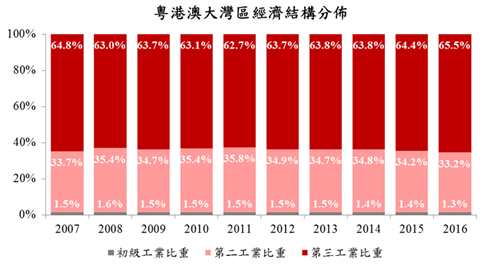
由於香港及澳門有超過90%經濟活動屬於服務業,大灣區製造業活動主要集中在廣東九市,其中東莞、佛山、江門、惠州、中山是不同商品的重要生產基地。根據大灣區的經濟結構組成,製造業一直以來對其經濟貢獻約三分之一。然而,自2011年開始,大灣區製造業對整體經濟的權重連續多年下降,由35.8%跌至2016年的33.2%,主因是製造業的增速不及第三工業,說明區內經濟正出現結構性調整。
資料來源:CEIC,中銀香港經濟研究

事實上,多項因素正推動大灣區製造業朝較高增值轉型發展。首先,工人成本不斷上漲,2016年廣東製造業工人的月均工資達到784美元,比多個新興市場國家為高;第二,新一代年青勞動力的學歷及文化程度較上一輩高,他們對工作條件、工資待遇及事業發展的要求較高,不願意從事勞動密集型的傳統製造業;第三,國內其他城市的工資及生活條件急起直追,這吸引外來人員回鄉就業,令廣東出現勞動力回流的跡象。此外,多年的高速增長令廣東的土地價值趨升,工業用地及工人居住的成本持續上升,令製造業的勞動力供應進一步緊張。

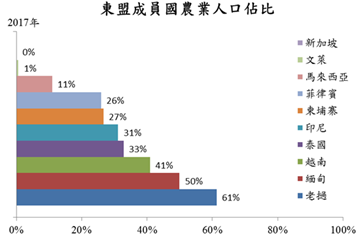
東盟擁有豐富的土地資源及龐大的人口紅利,而且地理上鄰近粵港澳大灣區,加上中國內地及香港都與東盟簽署自由貿易協定,這使得東盟成為大灣區製造業走出去的理想地。目前,東盟多個成員國仍有較高比例的農業人口,其中越南、緬甸及老撾有超過四成人口從事農業,整體有超過2億農民。隨著農業科技進步及城市化發展,東盟將釋出更多勞動力供應。在大灣區與東盟形成區域性供應鏈的過程中,大灣區企業可向產業的高價值領域發展,東盟則可受惠於製造業投資所帶來的工廠職位,提升民眾的收入及技術水平,令雙方的合作達至互利共贏。
資料來源:World Bank,中銀香港經濟研究


大灣區與東盟具備物流貿易中心的優勢

大灣區與東盟的共同優勢是其地理位置優越及擁有良好的交通基建。根據聯合國《2017年海洋運輸回顧》報告,在全球貨櫃吞吐量前40大的港口中,大灣區及東盟合共佔有10席,其中新加坡、深圳及香港更排名第二、第三及第五。此外,國際機場協會發布全球最繁忙的20大機場名單上,香港、廣州、雅加達及新加坡機場在總客運量分別排名第八、第十三、第十七及第十八,而香港更在總貨運量排名第一。這些數據不單說明大灣區和東盟的對外貿易活動十分活躍,同時突顯出雙方作為區域物流中心的樞紐地位。

大灣區建設的重點合作領域之一是要推進基礎設施互聯互通,特別是在交通基建方面,旨在構建高效便捷的現代化綜合交通運輸體系。大灣區內多個新落成的大型跨境項目(港珠澳大橋、廣深港高鐵、粵澳新通道)將可配合現有港口、機場、高鐵及高速公路網絡,令國際與中國市場的連結得到提升。再者,大灣區內需市場的增長前景樂觀,其中產階層不斷壯大。這些條件有助於大灣區發展成為中國與東盟接軌的經貿平台。現時,大灣區和東盟在物流方面有空間作進一步合作,例如:雙方主要的國際港口及機場可開闢新航線或增加航班數目,以促進大灣區與東盟之間貿易、旅遊及投資等商業活動。

另一方面,大灣區粵港澳三方可參考東盟推動自由貿易的創新措施。自2018年起,東盟的五個成員國印尼、馬來西亞、新加坡、泰國和越南開始實施貿易單一窗口,並接受成員國以電子方式交換產地來源證。東盟單一窗口的優點是透過建立共同的海關平台,使得貨物報關流程得以精簡化、標準化及一體化,為企業減低交易成本,從而提高東盟整體的貿易競爭力。大灣區涉及內地九個城市和兩個特區,粵港澳可考慮東盟單一窗口的模式,以解決制度不一的限制,令區內的貿易活動得到最大的便利。


大灣區可發揮基建融資功能,配合東盟的資金需要

東盟的基建發展一直未能趕及其經濟迅速增長的步伐,令不同基建及公共服務出現嚴重供給缺口。亞洲開發銀行指出,東盟每年平均需要投資2,100億美元,才能滿足區內的基建需要。

多年來,東盟的基建投資缺乏增長主要是受著兩大因素所致。首先,政府財政不足支持興建基礎設施的資金需要。東盟成員國雖然有充足的外匯儲備,而且其政府債務比率一般比其他新興市場為低,但1997年金融風暴的經驗令成員國嚴守財政紀律,使東盟政府用於發展基建的財政資源受到制約。其次,基建項目融資有別於其他金融資產類別,其規模大、投資年期長、風險因素多,因此可投資(investable)或可貸款(bankable)的項目需要相當高的專業要求,涉及領域包括:項目審核、設計、營運、建造、法律、保險、風險管理、企業財務管理等。東盟缺乏investable的基建項目令私人投資難以就風險及回報進行詳細評估,使其未有利用環球低息流動性大舉投資東盟項目。

大灣區的對外定位是培育國際合作,發揮城市群的獨特優勢,以推動一帶一路建設。其中,香港是國際金融、專業服務及仲裁中心,廣東省是內地企業、承建商及資金的集結地,這些優勢可協助大灣區打造成為東盟的海外基建融資中心。透過政策上的相互協調及合作,大灣區可開拓基建項目融資的相關產業活動,包括:提供全面的基建評估服務、解決基建項目風險及回報不對稱的問題、就不同階段的基建項目提供融資建議、發揮中介作用等,這些功能將有助東盟市場與內地及國際投資者進行對接。可見,大灣區的專業人才及平台角色已具備良好基礎,為東盟解決投資不足的問題,使基建資金得以到位。


大灣區與東盟有潛質共同發展創新科技

隨著資訊科技發展日新月異,大灣區城市群與東盟成員國可突破雙方在發展水平及人均收入的差異,在創新科技及數字經濟方面加強合作,以進一步發揮各自市場的人才資源及市場規模。

近年,流動互聯網及智能手機在東盟日漸普及化,為區內初創企業帶來大量增長空間,使其規模不斷壯大,並向國際市場擴張業務。享負盛名的初創企業包括:召車平台Grab及Go-Jek、電商平台Lazada及Tokopedia、一站式旅遊服務網站Traveloka、時裝網店Zalora、拍賣平台Carousell等,部份企業更已在香港及內地開設據點,說明東盟初創企業的實力不容小覷。

大灣區建設的一項合作目標是要發展創新和科技事業。在創科領域上,大灣區和東盟可推動多方面合作,以提高雙方的效率及培育經濟增長的技術元素。首先,雙方可建立一個創新資訊平台,透過舉辦研討會、企業互訪、投資配對、工作坊等活動,促進業界的交流及資源共享;第二,雙方可共同推出研究合作項目,以協助雙方企業抓住數字經濟轉型所帶來的增長機遇,例如:中小企業可如何利用電子商貿平台擴充其業務版圖、增加外國買家對自身產品或服務的認識;第三,由於大灣區和東盟兩大內部市場都面對著邊境及制度不一的問題,令初創企業的跨境發展受到限制。雙方可加強創科政策交流,就電子商貿徵稅、法例監管、網絡安全、知識產權、個人資料保障、資金流動等議題進行溝通及分享經驗,為企業營造有利於創新及科技發展的營商及監管環境。

總括而言,粵港澳城市群與東盟成員國都擁有良好的宏觀發展條件及較佳的增長前景。在一帶一路國際合作及大灣區建設的助力下,雙方可在區域製造業供應鏈、物流及貿易、基建融資、創新及科技等領域深化合作,以達致優勢互補,實現協同發展。


近期報告

1. 對特區政府新房屋措施的評估 蔡永雄 07.04
2. 全球強監管背景下數字貨幣融資發展探討 蘇傑 06.27
3. 中美貿易戰怎麼看? 柳洪 06.22
4. 2018年下半年香港經濟增長趨勢 蔡永雄 06.22
5. 粵港澳金融圈的戰略意義及香港新角色、新作用 應堅 06.20
6. 信用事件增加 風險相對可控 劉雅莹 06.19
7. 香港踏入加息週期及其影響 黃兆昌 06.15
8. 離岸人民幣快報 (2018年6月號總第52期) 張文晶、王晴、曾綺珺 06.14
9. 停用LIBOR的潛在影響分析 張文晶 05.29
10. 上市規則修訂後新經濟企業來港上市前景展望 蘇杰 05.24
11. 香港旅遊業的發展近況及前景 蔡永雄 05.18
12. 馬來西亞大選對中國投資項目的潛在影響及啓示 黃思華 05.18
13. 人民幣的國際儲備貨幣地位與中國的外匯儲備水平 戴道華 05.18
14. 離岸人民幣快報 (2018年5月號總第51期) 張文晶、王晴、曾綺珺 05.17
15. 對內地資管新規內容及影響的探析 鄂志寰、劉雅莹 05.09
16. 美國制裁中國通訊企業的影響及啟示 黃思華 05.07
17. 內地債券市場開放前景及影響 鄂志寰、劉雅莹 05.07
18. 港元利率步入正常化對住宅樓市的影響分析 蔡永雄 04.27
19. 落實利率並軌及利率進一步市場化的影響 劉雅瑩 04.20
20. 香港擁有港元匯率穩定的四大基石 戴道華 04.19

More articles from Bank of China (Hong Kong ) Limited

10 Aug 2017 Bank of China (Hong Kong ) Limited
習近平主席在「一帶一路」國際合作論壇開幕式的演講中從歷史和現實兩個維度出發,概括了「和平合作、開放包容、互學互鑒、互利共贏」的「一帶一路」理念,明確提出把「一帶一路」建成和平之路、繁榮之路、開放之路、創新之路和文明之路。 「一帶一路」作為中國在全球經濟新格侷下制定的頂層倡議,突破了傳統以貿易和投資便利化為主題的區域合作理念和方式,通過為沿綫各國提供共同受益的國際公共產品,為持續低迷的全球經濟增長提供新動力,亦為解決當前全球經濟貿易困境和維護多邊貿易體制主管道地位提供新的思路和中國方案。在「一帶一路」政策溝通、設施聯通、貿易暢通、資金融通、民心相通的五大主線中,資金融通具有系統重要性,建立高效、順暢的資金融通網絡和佈局是把「一帶一路」建成繁榮之路的重要一環。

By Philip Panaino, Regional Head, Transaction Banking, Africa & Middle East, Standard Chartered

SUMMARY

With the Belt and Road initiative fostering financial cooperation and trade in Africa, it makes economic sense for countries along the modern “Silk Road” to use the Chinese currency. The deepening trade relationship between China and Africa clearly points to a long-term story in which the RMB will play a more strategic role in facilitating cross-border trade.

Please click HERE to read more.

More articles from Standard Chartered Bank

12 Apr 2019 Standard Chartered Bank
By Mohamed Salama, Country Head of Global Banking, UAE, Standard Chartered   SUMMARY The UAE features prominently as a key component of China’s trade strategy in the AME region, as 60% of China-UAE trade is re-exported to Africa or Europe, thus supporting the Belt & Road Initiative’s mandate. Please click HERE to read more.
06 Mar 2019 Standard Chartered Bank
SUMMARY There are at least 65 countries involved in the Belt and Road Initiative, but which of them stand to benefit the most, and where has the money gone so far?   Please click HERE to read more.
27 Nov 2018 Standard Chartered Bank
By Kelvin Lau, Senior Economist, Greater China, Standard Chartered   SUMMARY Launched just five years ago, the Belt and Road Initiative has come a long way in a short time. While the rising risk of prolonged US-China trade dispute looks set to reshape the global trade and investment landscape, we believe that it could fuel B&R’s growth and make it even more important for the long-term development of China and its partner countries.   Please click HERE to read more.
12 Mar 2018 Standard Chartered Bank
By Kelvin Lau, Becky Liu, Chidu Narayanan SUMMARY Things are looking up for Renminbi internationalisation in 2018. The CNY has been off to a strong start to 2018, and barring a full-fledged trade war, it is expected that the Chinese authorities will allow further CNY appreciation against a weak USD backdrop while keeping the CNY basket value steady. The Dim Sum bond market is expected to have a revival as gross issuance picked up evidently in January. Please click HERE to read more.
14 Feb 2018 Standard Chartered Bank
SUMMARY For international investors looking for the next big opportunity, China’s ‘new economy’ companies offer plenty. China’s Belt and Road (B&R) initiative – which involves large-scale infrastructure development along China’s centuries-old trade routes across Asia, Africa, the Middle East and Europe – is part of the solution to ensure Chinese companies continue growing.There is also opportunity for global investors. Please click here to read the full article. By Clive McDonnell
17 Jan 2018 Standard Chartered Bank
SUMMARY At a time when the US and other global economies appear to have turned their back on globalisation, China is pursuing an ambitious global agenda. And one initiative central to China’s plans is Belt and Road. Please click here to read the full article. By Shuang Ding

The Belt and Road Initiative (BRI) undoubtedly offers tremendous opportunities for countries along each of the corridors and for the countless organisation who will play a part in its progress. Yet the project also faces a number of issues that will be critical to the eventual success of the initiative, not least the challenge of social acceptance.

For design and engineering firms such as Arup, it is easy to look at BRI as a series of large-scale infrastructure projects. In reality though, it is a multi-faceted development whose core principles cover everything from policy coordination and trade freedoms to financial integration and globalization.

Ultimately, infrastructure is – always and everywhere – political. There are always strategic interests involved and there can be losers as well as winners. So even when the number of winners far outstrips the losers and there is a compelling case to build, we must always do our best for those who don’t see a critical new rail link, for example, but rather, the loss of land that has been farmed by a community for generations.

That is why Arup has signed up to the UN’s Sustainable Development Goals to try and ensure that all the work we do matches our mission to shape a better world.

Good infrastructure is fundamental to improving people’s lives – creating jobs, supporting trade, providing affordable energy and clean water, as well as reducing poverty. So we must drive home the crucial point that investing in infrastructure can and should be win-win, not a zero sum game.

We have to reinforce the critical truth that trade, growth, job creation and poverty reduction all rely on a virtuous circle that relies on efficient, resilient networks that link people, goods and services between and within countries, regions and cities.

In doing so, we must ensure we are building the right infrastructure for the right reasons. We must ensure that we do not focus on capex costs at the expense of lifetime costs. And we must ensure that major schemes are sustainable socially, environmentally as well as economically, to avoid storing up serious political risks for the future.

The good news is that there is no shortage of skills and expertise available to ensure that the BRI is planned and built to the standards of planning, design, resilience and economic sustainability that will get the job done in the right way.

President Xi Jinping has said that China wants a sustainable Belt & Road and it is critical that we follow this ambition. Truly resilient projects that deliver for the economy, for the environment, and for the people are the key to making the Belt & Road Initiative a success.

More articles from Arup

04 Sep 2019 Arup
“People tend to look at output… but actually, we should look at the outcome. What does this piece of infrastructure have to do with the social and economic development of that location?” points out Arup’s East Asia Region Chair, Michael Kwok. “That is why Belt and Road makes so much sense – not only in terms of supporting the development of a country, but actually in supporting the ambitions of shaping a better world.” Speaking in a video for the Hong Kong Trade Development Council, Michael described the BRI – an ambitious, large-scale programme to connect Asia, Africa and Europe via land and maritime networks – as a very important initiative not just for China, but for the world. He believes that Hong Kong is playing a vital role in helping to shape the Belt and Road Initiative due to its internationalism, openness and pragmatism. Pioneering digital transformation work in Hong Kong, particularly around 3D printing, automation and artificial intelligence,
04 Sep 2019 Arup
Image used under license from shutterstock.com The government of the Philippines has embarked on an ambitious “Build, Build, Build” infrastructure programme to spur economic growth throughout the country. According to the government, a total of PhP8.4 trillion (US$170 billion) will be spent for infrastructure during the six-year term of the Duterte administration. This will increase the infrastructure spending in the GDP from 3.4% in 2016 to 7.4% by 2022.   Challenges facing The Philippines is one of the fastest growing economies in Asia averaging more than 6% growth over the past decade. However, infrastructure spending has lagged behind its neighbours. The crumbling infrastructure has resulted in transport and economic woes and has been identified as one of the most significant constraints sustaining to the country’s economic growth.   Underdeveloped infrastructure is attributed to the following factors: inadequate infrastructure investment
19 Jan 2018 Arup
Rail networks are an important part of the Belt and Road initiative to improve connectivity along the historical Silk Road trading routes, and stations are powerful catalysts for development and regeneration. How are transport hubs evolving to meet local needs? What can we learn from trends in Europe and North America? Malcolm Smith, Arup’s Global Masterplanning and Urban Design Leader shares his perspective.   Train stations were places of wonder in the 19th century. The buildings, like the trains within, symbolised technological progress and economic power. These ‘palaces’ of the industrial age were awe-inspiring in their sheer size, dramatic in architecture and feats of engineering. St Pancras Station in London was one such example and on its completion in 1868, was the largest enclosed space in the world. This has allowed it to be remodeled into today’s spectacular transport hub. © Hufton+Crow The redevelopment of King’s Cross station represents a co
06 Dec 2017 Arup
Preparing for widespread growth Rapid growth in energy demand across Asia is seeing LNG become the fuel of choice. Driven by expanding populations, rising standards of living, and sprawling urbanisation, demand will only keep growing. With LNG production and transportation at an all-time high, Asia is seeing new opportunities for both land-based import terminals as well as floating storage and regasification facilities. This trend is set to keep on going, with energy growth predictions for Asia much higher than the rest of the world. Japan and Korea have long relied on LNG for energy security and power generation, but we’re now seeing a change across Asia. China, India, Indonesia, the Philippines, Thailand, Vietnam and Bangladesh have followed suit with the recent introduction of gas into their import markets and are helping to drive demand across the region. As demand increases, new ways of bringing large-scale power generation online quickly needs to be found to meet thes
18 Oct 2017 Arup
Sustainable and resilient infrastructure design is vital for the Belt & Road… not just for Asia, but for the world as well Just over four years after President Xi Jinping first launched his vision for the Belt and Road Initiative (BRI), the concept is fast becoming a reality. With a vision of reform, development, trade and innovation at the heart of the concept, BRI is set to reshape and revitalise trade links around the globe. The countries along the various corridors account for some two-thirds of the world’s population, but only one third of the world’s GDP. So there is tremendous potential for growth. And the new infrastructure developed under the BRI banner will be the key to the unlocking this potential. That is not to say that some of this infrastructure would not be built without BRI, of course. In fact, the Asia Development Bank estimated that some US$1.7 trillion per annum would be required for infrastructure investment in Asia between 2016-2030 at current

By Kelvin Lau, Becky Liu, Chidu Narayanan

SUMMARY

Things are looking up for Renminbi internationalisation in 2018. The CNY has been off to a strong start to 2018, and barring a full-fledged trade war, it is expected that the Chinese authorities will allow further CNY appreciation against a weak USD backdrop while keeping the CNY basket value steady. The Dim Sum bond market is expected to have a revival as gross issuance picked up evidently in January.

Please click HERE to read more.

More articles from Standard Chartered Bank

12 Apr 2019 Standard Chartered Bank
By Mohamed Salama, Country Head of Global Banking, UAE, Standard Chartered   SUMMARY The UAE features prominently as a key component of China’s trade strategy in the AME region, as 60% of China-UAE trade is re-exported to Africa or Europe, thus supporting the Belt & Road Initiative’s mandate. Please click HERE to read more.
06 Mar 2019 Standard Chartered Bank
SUMMARY There are at least 65 countries involved in the Belt and Road Initiative, but which of them stand to benefit the most, and where has the money gone so far?   Please click HERE to read more.
27 Nov 2018 Standard Chartered Bank
By Kelvin Lau, Senior Economist, Greater China, Standard Chartered   SUMMARY Launched just five years ago, the Belt and Road Initiative has come a long way in a short time. While the rising risk of prolonged US-China trade dispute looks set to reshape the global trade and investment landscape, we believe that it could fuel B&R’s growth and make it even more important for the long-term development of China and its partner countries.   Please click HERE to read more.
17 Jul 2018 Standard Chartered Bank
By Philip Panaino, Regional Head, Transaction Banking, Africa & Middle East, Standard Chartered SUMMARY With the Belt and Road initiative fostering financial cooperation and trade in Africa, it makes economic sense for countries along the modern “Silk Road” to use the Chinese currency. The deepening trade relationship between China and Africa clearly points to a long-term story in which the RMB will play a more strategic role in facilitating cross-border trade. Please click HERE to read more.
14 Feb 2018 Standard Chartered Bank
SUMMARY For international investors looking for the next big opportunity, China’s ‘new economy’ companies offer plenty. China’s Belt and Road (B&R) initiative – which involves large-scale infrastructure development along China’s centuries-old trade routes across Asia, Africa, the Middle East and Europe – is part of the solution to ensure Chinese companies continue growing.There is also opportunity for global investors. Please click here to read the full article. By Clive McDonnell
17 Jan 2018 Standard Chartered Bank
SUMMARY At a time when the US and other global economies appear to have turned their back on globalisation, China is pursuing an ambitious global agenda. And one initiative central to China’s plans is Belt and Road. Please click here to read the full article. By Shuang Ding

By Derrick Khoo, General Counsel, Marga Group

Like a phoenix rising out of the fire, Myanmar is soaring and embracing its new role as the go-to investment destination in Asia. To spur the country forward, the Myanmar government has wisely emphasised on the introduction of new modern laws and revision of obsolete ones as a key priority for its administration.

Recent encouraging developments in the Myanmar legal landscape are clear signs that the country is headed in the right direction to further cement businesses’ and investors’ confidence. Various progressive laws have been discussed, in consultation with industry stakeholders and the general public, and as advised by leading law firms. Many of these have already or are slated to take effect.

For example, the Condominium Law (2016) and its implementing rules (2017) have allowed foreigners to own units in a qualifying “condominium”. The Myanmar Investment Law (2017) combined the previous two separate regimes of Foreign Investment Law (2012) and the Citizens Investment Law (2013) to provide a level-playing field for foreign and local investors alike. Among many developments introduced by the Myanmar Investment Regulations (2017), one that stands out is the permitting of foreign investors to now enter into long-term leases subject to qualifying conditions, and this has also been affirmed by the relevant authorities.

The most anticipated change in recent times comes in the form of the New Myanmar Companies Law which was passed into law by President U Htin Kyaw on 6 December 2017 and is expected to come into effect in August 2018. This will replace the existing Myanmar Companies Act 1914 and will be largely similar to prevailing company law regimes in Hong Kong, Singapore and other common law jurisdictions. In anticipation of this, the Directorate of Investment and Company Administration (DICA) intends to release a model constitution for private companies limited by shares – this is currently at the public consultation and feedback stage.

The most exciting change that the New Myanmar Companies Law introduces is that foreigners are now permitted to own up to 35% shareholding in a local Myanmar company whilst still retaining the company’s status as a local company and thereby allowing foreigners a minority stake to invest in sectors or economic activities that are reserved for Myanmar companies, such as ownership of land or investment in “locals-only” industries. In addition, this effectively means that foreigners are now not restricted from trading public stocks on the Yangon Stock Exchange, subject to the 35% threshold.

The New Myanmar Companies Law also codifies directors’ duties, minority shareholder protection rights, and shareholder derivative rights, effectively adopting current corporate governance best practices found in other jurisdictions. In terms of structuring, corporate group structures were previously not frequently used in practice due to policy reasons, however the New Myanmar Companies Law now expressly recognises the use of them and includes provisions regarding managing of corporate groups.

Another welcome clarification by the New Myanmar Companies Law will undoubtedly facilitate much-needed loans from foreign banks to Myanmar companies with property interests. Under the existing regime, the mortgage of immovable property to a foreign person is prohibited by the Transfer of Immovable Property (Restrictions) Law 1987. This prevented many foreign banks from making loans to Myanmar companies as the foreign banks were unable to take security over property and property interests. The New Myanmar Companies Law expressly removes this restriction by explicitly stating that granting of security to foreign persons is permitted under the law and the exercise of such security is not in breach of such law.

These crucial developments in the legal landscape are just some of the many that are being planned or have already been passed. Whilst they take root, they will continue to be tested and challenged, and only continued persistence, tenacity and a strong rule of law will allow them to continue to grow and flourish. Myanmar has indeed progressed rapidly on many fronts since opening up its market in 2010, and a more attractive and vibrant investment climate heralds those who are quick to seize the moment.

More articles from Dashun Foundation

SUMMARY

For international investors looking for the next big opportunity, China’s ‘new economy’ companies offer plenty. China’s Belt and Road (B&R) initiative – which involves large-scale infrastructure development along China’s centuries-old trade routes across Asia, Africa, the Middle East and Europe – is part of the solution to ensure Chinese companies continue growing.There is also opportunity for global investors.

Please click here to read the full article.

By Clive McDonnell

More articles from Standard Chartered Bank

12 Apr 2019 Standard Chartered Bank
By Mohamed Salama, Country Head of Global Banking, UAE, Standard Chartered   SUMMARY The UAE features prominently as a key component of China’s trade strategy in the AME region, as 60% of China-UAE trade is re-exported to Africa or Europe, thus supporting the Belt & Road Initiative’s mandate. Please click HERE to read more.
06 Mar 2019 Standard Chartered Bank
SUMMARY There are at least 65 countries involved in the Belt and Road Initiative, but which of them stand to benefit the most, and where has the money gone so far?   Please click HERE to read more.
27 Nov 2018 Standard Chartered Bank
By Kelvin Lau, Senior Economist, Greater China, Standard Chartered   SUMMARY Launched just five years ago, the Belt and Road Initiative has come a long way in a short time. While the rising risk of prolonged US-China trade dispute looks set to reshape the global trade and investment landscape, we believe that it could fuel B&R’s growth and make it even more important for the long-term development of China and its partner countries.   Please click HERE to read more.
17 Jul 2018 Standard Chartered Bank
By Philip Panaino, Regional Head, Transaction Banking, Africa & Middle East, Standard Chartered SUMMARY With the Belt and Road initiative fostering financial cooperation and trade in Africa, it makes economic sense for countries along the modern “Silk Road” to use the Chinese currency. The deepening trade relationship between China and Africa clearly points to a long-term story in which the RMB will play a more strategic role in facilitating cross-border trade. Please click HERE to read more.
12 Mar 2018 Standard Chartered Bank
By Kelvin Lau, Becky Liu, Chidu Narayanan SUMMARY Things are looking up for Renminbi internationalisation in 2018. The CNY has been off to a strong start to 2018, and barring a full-fledged trade war, it is expected that the Chinese authorities will allow further CNY appreciation against a weak USD backdrop while keeping the CNY basket value steady. The Dim Sum bond market is expected to have a revival as gross issuance picked up evidently in January. Please click HERE to read more.
17 Jan 2018 Standard Chartered Bank
SUMMARY At a time when the US and other global economies appear to have turned their back on globalisation, China is pursuing an ambitious global agenda. And one initiative central to China’s plans is Belt and Road. Please click here to read the full article. By Shuang Ding

Rail networks are an important part of the Belt and Road initiative to improve connectivity along the historical Silk Road trading routes, and stations are powerful catalysts for development and regeneration. How are transport hubs evolving to meet local needs? What can we learn from trends in Europe and North America? Malcolm Smith, Arup’s Global Masterplanning and Urban Design Leader shares his perspective.


Train stations were places of wonder in the 19th century. The buildings, like the trains within, symbolised technological progress and economic power. These ‘palaces’ of the industrial age were awe-inspiring in their sheer size, dramatic in architecture and feats of engineering. St Pancras Station in London was one such example and on its completion in 1868, was the largest enclosed space in the world. This has allowed it to be remodeled into today’s spectacular transport hub.

1.jpg

© Hufton+Crow

The redevelopment of King’s Cross station represents a compelling piece of place-making for London.


By the second half of the 20th century, with car travel on the rise, train stations in many parts of the world lost prominence as cities planned for greater road use – undermining the prestige of rail travel. Now, as passenger numbers increase, rail is playing a central role in urban life; the economic and cultural importance of stations is increasing.


A need for high-quality, beautiful, yet flexible stations, integrated into their place in the city has emerged. Investment programmes have modernised and expanded many stations across Europe and North America. Arnhem Central Station is one example: dating back to 1845, the station has been completely redeveloped to better meet today’s travel needs. It was opened late 2015. In other regions, the focus is more often on the construction of new public transport systems, like Shenzhen Metro’s new Line 4 - 15 stations built with provision for development above.


2.jpg

© Kenny Ip

Shenzhen Line 4 (Longhua Line) was designed with provision for topside development in the densely populated city.


“Driving this need for integration is the fundamental question of what a station contributes – economically and socially – to a city.”

  • Malcolm Smith, Global Masterplanning and Urban Design Leader, Arup


This renaissance brings new expectations. Some rail and metro stations, such as Cityringen in Copenhagen, are designed to be places of transit, prioritising citizens’ desire for simple journeys without distraction. In other stations, designers are called on to create dynamic, multifunctional spaces where people can do much more than set out or arrive on a journey. They are destinations in their own right, providing space for everything from libraries, medical centres and cinemas, to shopping and eating.


3.jpg

©Arup

Design of the new stations on Copenhagen’s Cityringen reflects the Scandinavian minimalism.


This requires greater flexibility – as seen in Canary Wharf’s new Crossrail station, where the commercial space can be completely redesigned to meet tenant needs – this in turn needs careful planning and design. What’s known as the ‘red line’ that separates travel spaces from public spaces is more blurred. To get this right, station designers must become more open to involving the community in defining what their station is, what it will contain and how it contributes to the surrounding area.


Passenger needs are paramount, and considered at every stage of the planning process. The aim is to create stations that allow people to move through them – and pause within and around them – with ease, rather than simply in the way transport authorities think is best. At London’s King’s Cross Station, we modelled the expected flow of people in and around the station in minute detail, to get the design right. We must ‘design in’ flexibility, so that as people’s needs evolve stations can be adapted easily and quickly.


4.jpg

©Hufton+Crow

The freeform concrete interior of the Arnhem Central Station promotes fluid passenger transition.


As stations become more flexible, they can also become more fun. Ikea certainly surprised passengers of the Parisian metro system when it placed a selection of its sofas on station platforms for people to test – and buy. Stations will always need to be places of safety and security, but there is no reason why they can’t delight and entertain.


Rail and metro stations are powerful catalysts for regeneration. More than ever, stations are symbols of a place, and need to be seamlessly integrated into the personalities of the cities in which they are located.

5.jpg

© James Ewing

Fulton Center in New York is a stunning new hub that allows people to get to their different destinations easily.


View the original article at https://www.arup.com/perspectives/themes/transport/cities-and-stations

More articles from Arup

04 Sep 2019 Arup
“People tend to look at output… but actually, we should look at the outcome. What does this piece of infrastructure have to do with the social and economic development of that location?” points out Arup’s East Asia Region Chair, Michael Kwok. “That is why Belt and Road makes so much sense – not only in terms of supporting the development of a country, but actually in supporting the ambitions of shaping a better world.” Speaking in a video for the Hong Kong Trade Development Council, Michael described the BRI – an ambitious, large-scale programme to connect Asia, Africa and Europe via land and maritime networks – as a very important initiative not just for China, but for the world. He believes that Hong Kong is playing a vital role in helping to shape the Belt and Road Initiative due to its internationalism, openness and pragmatism. Pioneering digital transformation work in Hong Kong, particularly around 3D printing, automation and artificial intelligence,
04 Sep 2019 Arup
Image used under license from shutterstock.com The government of the Philippines has embarked on an ambitious “Build, Build, Build” infrastructure programme to spur economic growth throughout the country. According to the government, a total of PhP8.4 trillion (US$170 billion) will be spent for infrastructure during the six-year term of the Duterte administration. This will increase the infrastructure spending in the GDP from 3.4% in 2016 to 7.4% by 2022.   Challenges facing The Philippines is one of the fastest growing economies in Asia averaging more than 6% growth over the past decade. However, infrastructure spending has lagged behind its neighbours. The crumbling infrastructure has resulted in transport and economic woes and has been identified as one of the most significant constraints sustaining to the country’s economic growth.   Underdeveloped infrastructure is attributed to the following factors: inadequate infrastructure investment
27 Jun 2018 Arup
The Belt and Road Initiative (BRI) undoubtedly offers tremendous opportunities for countries along each of the corridors and for the countless organisation who will play a part in its progress. Yet the project also faces a number of issues that will be critical to the eventual success of the initiative, not least the challenge of social acceptance. For design and engineering firms such as Arup, it is easy to look at BRI as a series of large-scale infrastructure projects. In reality though, it is a multi-faceted development whose core principles cover everything from policy coordination and trade freedoms to financial integration and globalization. Ultimately, infrastructure is – always and everywhere – political. There are always strategic interests involved and there can be losers as well as winners. So even when the number of winners far outstrips the losers and there is a compelling case to build, we must always do our best for those who don’t see a critical new rail lin
06 Dec 2017 Arup
Preparing for widespread growth Rapid growth in energy demand across Asia is seeing LNG become the fuel of choice. Driven by expanding populations, rising standards of living, and sprawling urbanisation, demand will only keep growing. With LNG production and transportation at an all-time high, Asia is seeing new opportunities for both land-based import terminals as well as floating storage and regasification facilities. This trend is set to keep on going, with energy growth predictions for Asia much higher than the rest of the world. Japan and Korea have long relied on LNG for energy security and power generation, but we’re now seeing a change across Asia. China, India, Indonesia, the Philippines, Thailand, Vietnam and Bangladesh have followed suit with the recent introduction of gas into their import markets and are helping to drive demand across the region. As demand increases, new ways of bringing large-scale power generation online quickly needs to be found to meet thes
18 Oct 2017 Arup
Sustainable and resilient infrastructure design is vital for the Belt & Road… not just for Asia, but for the world as well Just over four years after President Xi Jinping first launched his vision for the Belt and Road Initiative (BRI), the concept is fast becoming a reality. With a vision of reform, development, trade and innovation at the heart of the concept, BRI is set to reshape and revitalise trade links around the globe. The countries along the various corridors account for some two-thirds of the world’s population, but only one third of the world’s GDP. So there is tremendous potential for growth. And the new infrastructure developed under the BRI banner will be the key to the unlocking this potential. That is not to say that some of this infrastructure would not be built without BRI, of course. In fact, the Asia Development Bank estimated that some US$1.7 trillion per annum would be required for infrastructure investment in Asia between 2016-2030 at current

SUMMARY

At a time when the US and other global economies appear to have turned their back on globalisation, China is pursuing an ambitious global agenda. And one initiative central to China’s plans is Belt and Road.

Please click here to read the full article.

By Shuang Ding

More articles from Standard Chartered Bank

12 Apr 2019 Standard Chartered Bank
By Mohamed Salama, Country Head of Global Banking, UAE, Standard Chartered   SUMMARY The UAE features prominently as a key component of China’s trade strategy in the AME region, as 60% of China-UAE trade is re-exported to Africa or Europe, thus supporting the Belt & Road Initiative’s mandate. Please click HERE to read more.
06 Mar 2019 Standard Chartered Bank
SUMMARY There are at least 65 countries involved in the Belt and Road Initiative, but which of them stand to benefit the most, and where has the money gone so far?   Please click HERE to read more.
27 Nov 2018 Standard Chartered Bank
By Kelvin Lau, Senior Economist, Greater China, Standard Chartered   SUMMARY Launched just five years ago, the Belt and Road Initiative has come a long way in a short time. While the rising risk of prolonged US-China trade dispute looks set to reshape the global trade and investment landscape, we believe that it could fuel B&R’s growth and make it even more important for the long-term development of China and its partner countries.   Please click HERE to read more.
17 Jul 2018 Standard Chartered Bank
By Philip Panaino, Regional Head, Transaction Banking, Africa & Middle East, Standard Chartered SUMMARY With the Belt and Road initiative fostering financial cooperation and trade in Africa, it makes economic sense for countries along the modern “Silk Road” to use the Chinese currency. The deepening trade relationship between China and Africa clearly points to a long-term story in which the RMB will play a more strategic role in facilitating cross-border trade. Please click HERE to read more.
12 Mar 2018 Standard Chartered Bank
By Kelvin Lau, Becky Liu, Chidu Narayanan SUMMARY Things are looking up for Renminbi internationalisation in 2018. The CNY has been off to a strong start to 2018, and barring a full-fledged trade war, it is expected that the Chinese authorities will allow further CNY appreciation against a weak USD backdrop while keeping the CNY basket value steady. The Dim Sum bond market is expected to have a revival as gross issuance picked up evidently in January. Please click HERE to read more.
14 Feb 2018 Standard Chartered Bank
SUMMARY For international investors looking for the next big opportunity, China’s ‘new economy’ companies offer plenty. China’s Belt and Road (B&R) initiative – which involves large-scale infrastructure development along China’s centuries-old trade routes across Asia, Africa, the Middle East and Europe – is part of the solution to ensure Chinese companies continue growing.There is also opportunity for global investors. Please click here to read the full article. By Clive McDonnell

本文以商務部對外勞務合作業務統計數據為依據,從國家(地區)、行業、企業三個維度對2017年1-11月中國勞務合作業務情況進行分析,供會員企業了解行業情況,未經授權不得轉載或鏡像。

請按此閱覽原文

More articles from China International Contractors Association

17 Jul 2018 China International Contractors Association
2017年,在國際工程市場需求總體萎縮、國際貿易主義抬頭的嚴峻形勢下,對外承包工程企業圍繞「一帶一路」倡議加大市場投入,增強開拓力度,整體業務規模穩步攀升,實現完成營業額1686億美元,同比增長5.8%,新簽合同額2653億美元,同比增長8.7%。行業企業「走出去」積極性不斷提升,隊伍逐步擴大,不少企業將促進海外業務發展上升到公司戰略層面,積極進行業務轉型升級,有效實現了業務發展,國際影響力得到了不斷提升。   2017年行業發展特點 一、從市場分佈來看,業務加速向「一帶一路」沿線國家集中 2017年,行業企業在「一帶一路」沿線國家市場新簽合同額1443億美元,占同期新簽合同額的54.4%,完成營業額855億美元,占同期總額的50.7%,主要合作領域涉及互聯互通和基礎設施建設、產能合作、能源、產業園區等。 亞�
04 Jun 2019 China International Contractors Association
信用保险项下项目融资业务是指我公司中长期保险和投资保险项下融资,针对的是出口买方信贷项目和出口卖方信贷项目以及海外投资项目,它适用于大型工程承包、机电成套设备出口及海外投资企业的融资。我公司通过对银行贷款提供风险保障支持银行满足相关企业项目融资需求或通过赔款转让协议将银行对相关企业的融资风险提供保障。   一、出口卖方信贷保险项下融资 是我公司提供的一类政策性保险产品,它以扩大我国出口、保障企业收汇为目的,对因政治风险或商业风险引起的出口方在商务合同项下应收的延付款损失承担赔偿责任。经我公司同意,出口方在将保单项下的赔偿权益转让给贷款银行,可以向银行申请融资。如进口方未按商务合同规定偿还到期款项致使出口方无法获得货款归还银行贷款时,我公司根据《赔款权益转�
24 May 2019 China International Contractors Association
黨的十九大報告指出,我國經濟已由高速增長階段轉向高品質發展階段,正處在轉變發展方式、優化經濟結構、轉換增長動力的攻關期。這是我國根據國際國內環境變化,特別是我國發展條件和發展階段變化做出的重大判斷。 對外承包工程行業的高品質發展,離不開企業的高品質發展,而企業的高品質發展離不開高品質的基礎設施項目。在「一帶一路」倡議的指引下,越來越多的中資企業投身沿線重大項目建設,推動對外承包工程行業發展取得長足進步。同時,在行業快速發展的過程中,各種挑戰、矛盾、風險開始逐漸顯現。 近年來,中國鐵建堅持「共商、共建、共用」基本原則,牢固樹立新發展理念,以打造高品質的基礎設施為目標,深入推動理念創新、模式創新、管理創新,在參與「一帶一路」重大項目建設上取得了歷史性突破,在推�
Help us to improve