






Latin America: Shaping the Future with Sustainability in Brazil
Brazil is renowned for its commitment to a greener economy and biodiversity preservation. It was the first country in the world to evaluate the performance of all its cities in achieving Sustainable Development Goals (SDGs).
Brazil has in place several nationwide sustainability plans and is an active participant in global action. Through its sustainability plans the country is working to reduce carbon emissions, promote renewable energy and protect biodiversity. Meanwhile, on the international stage, Brazil shows leadership by hosting major events like the G20 Summit in 2024 and the 30th Conference of the Parties to the United Nations Framework Convention on Climate Change (UNFCCC COP 30) in 2025.
Given Brazil’s ongoing progress towards sustainability, HKTDC Research conducted a market research trip to gather the latest information on the developments and trends in the country.
Net zero by 2050
Known for its vast Amazon rainforest and rich biodiversity, Brazil works hard to achieve harmony with mother nature. In addition to being the first G20 country to monitor and evaluate the Sustainable Development Goals (SDGs) performance of all its cities, Brazil has rolled out transformative initiatives to embed sustainability into its economic development. [1]
In terms of sustainability targets, Brazil continues to advance its agenda in accordance with international standards with new commitments. In 2023, Brazil signed a Sustainability Development Cooperation Framework 2023-2027 with the United Nations (UNSDCF), which aligns Brazil's national development priorities with UN’s system. [2] During COP 29 in November 2024, Brazil made a new commitment on its greenhouse gas (GHG) emissions reduction target, aiming to reduce the emissions further by 59% to 67% by 2035 from 2005 levels, thus achieving net‑zero by 2050. [3]
Anchored to the framework and its new sustainability target, Brazil launched several plans to accelerate its progress in different directions. Launched in 2023, the Ecological Transformation Plan (Plano de Transformação Ecológica), also known as Novo Brasil (New Brazil), aims to enhance green‑related productivity and drive inclusive, sustainable economic development by integrating fiscal reforms and technological innovations.
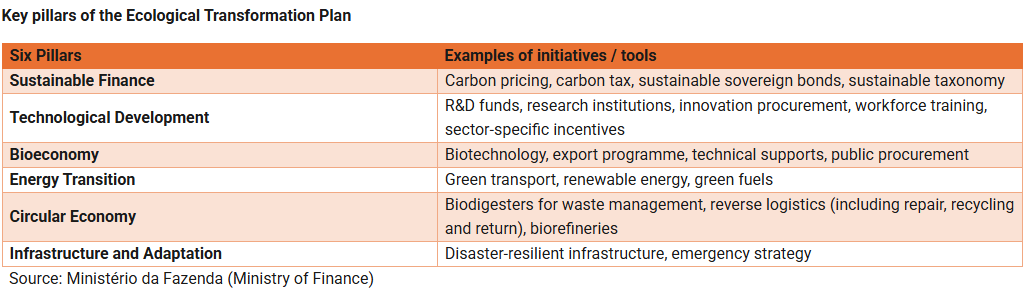
To integrate sustainability into its economic framework, the Brazilian Government has introduced several schemes that address specific targets for decarbonisation. These include Eco Invest Brasil, the National Energy Transition Policy (Política Nacional de Transição Energética, PNTE), the National Hydrogen Programme (Programa Nacional do Hidrogênio, PNH2), and others. While not all of these plans are directly partly of the Ecological Transformation Plan, these specialised policies complement the overarching framework with sectoral roadmaps and goals.
Burgeoning green finance
Brazil's green finance ecosystem is pivotal to its sustainability goals. Among all the financial programmes in Brazil, Eco Invest Brasil launched in 2024 is one of the new incentives which is also part of the Ecological Transformation Plan.
Eco Invest Brasil aims to attract both local and foreign investments in Brazil’s ecological transition. The programme offers credit lines for sustainability development, fostering investments in projects promoting a sustainable economy, attracting foreign investment, enhancing Brazilian companies’ access to the global financial system, and developing a FX hedge market.
To enhance the stability and attractiveness of the programme, Brazil’s Ministry of Finance collaborates with key financial institutions, such as the World Bank, the Banco Central do Brasil, BNDES and Banco de Brasil, etc, which provide favourable conditions and technical supports for the implementation.
As one of the major financial instruments channelling investments in Brazil’s ecological transition, as of 13 October 2025, Eco Invest Brasil has mobilised over R$75 billion (around US$13.4 billion) to support eco‑friendly projects. [4] The fundings will be utilised in projects particularly relevant to the key pillars of the Ecological Transformation Plan, including restoration of degraded land areas, new sustainable technologies, sustainable aviation fuel (SAF), and others. In late 2025, the programme is expected to attract another round of investment to support projects on environmental conservation and bioeconomy.
Pioneer in hydropower
Brazil is a leader in energy transition, generating around 90% of its electricity from renewables in 2024. Hydropower is the largest source, accounting for 56% of the electricity generation in that year, followed by wind (14%), solar (10%) and biofuels (8%). Non‑renewable energies account for only 10% of the total. Brazil seeks to improve its production of renewable energies over the next decade.
To maintain these achievements, Brazil introduced its National Energy Transition Policy (PNTE) in 2024, focusing on transforming Brazil's industry on a sustainable basis. It seeks to invest R$2 trillion (US$360 billion) by 2030 in green energies such as biofuels, green hydrogen, and SAF.
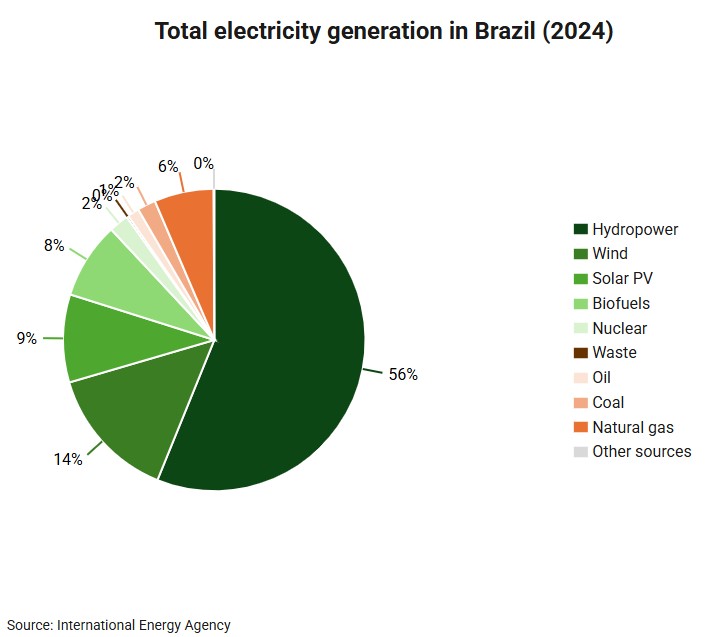
The high proportion of hydropower in Brazil is largely due to Itaipu Binacional, one of the world’s largest hydroelectric dams. Located on the border between Brazil and Paraguay, the Itaipu Binacional Hydroelectric Plant has 20 generating units with a total capacity of 14.0 gigawatts.
Brazil has decided to accelerate its hydrogen market, aiming to position the country as a global leader in low‑carbon hydrogen production in the years ahead. Tax credits and investment will support the development of low‑carbon hydrogen, with the goal of expanding the industrial capacity and increasing export potential in regions such as Ceará (the Pecém Free Trade Zone) and Piauí (the Parnaíba Free Trade Zone). To support these efforts, Brazil launched the Hydrogen Portal in September 2025 to consolidate strategic data, regulatory information and project status in supporting investments, decision‑making and strategic planning.
Resurgence of biofuels
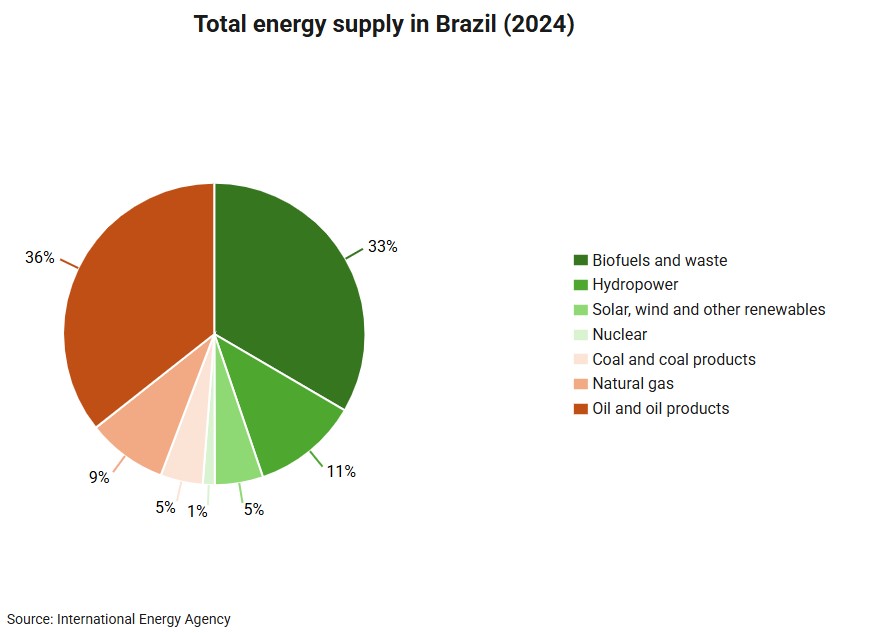
Thanks to its rich biodiversity, Brazil is a major exporter of agricultural products, and is also a major producer of biofuels. In 2024, biofuels accounted for over 33% in Brazil’s energy supply. In fact, Brazil has been promoting biofuels for a long time, since the blending of biodiesel with diesel fuel was mandated in 2005. Looking ahead, Brazil aims to produce 48.5 billion litres of bioethanol and 13.6 billion litres of biodiesel by 2034, in order to steer its sectors towards a more sustainable economy.
Throughout Brazil’s biofuel journey, CIBiogás, a Brazilian non‑profit technology and innovation institute that promotes biogas development, has played a key role in promoting biofuel as a clean and competitive energy resource. It operates laboratories and pilot plants for testing biogas production, upgrading, and utilisation, focusing on converting organic waste from industries into renewable energy sources, particularly biogas and biomethane.
To encourage Brazilian firms to adopt biofuel, CIBiogás has created a collaborative platform Biogas Club. Currently, the Club has established a network of over 50 institutions and companies to advance the biogas market with technological solutions, such as biodigesters for domestic farms. The scientific experts working in CIBiogás foster the energy transition of Brazilian companies by offering technical and strategic consultancy on the production and use of biofuels.
CIBiogás’ contribution to Brazil’s biofuel development is exemplified by its partnership with Frimesa, a major pork and dairy cooperate in Brazil. Providing technological consultancy, CIBiogás has helped Frimesa transform slaughterhouse biowaste into biogas, which is used in their pig charring process in lieu of traditional liquefied petroleum.
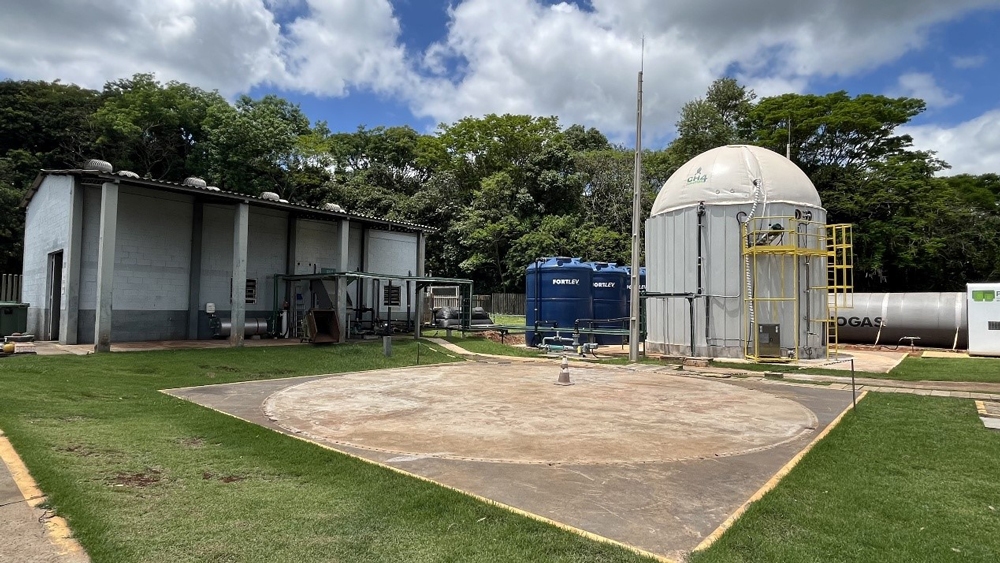
CIBiogás has been promoting biofuel via their R&D, biogas plants and production and international collaborations. Source: HKTDC Research
Partnership on sustainability
Committed to achieving net‑zero by 2050, Brazil is ambitious in transforming itself into a low‑carbon economy. Its previous endeavours pave the way for new national strategic initiatives for sustainability that better integrate the economy with nature. These plans align economic growth with sustainability by buttressing resources and policies across regulation, energy, finance, innovation, and infrastructure. Brazil also prioritises biodiversity protection and social development, focusing on deforestation control and the conservation of indigenous communities.
Meanwhile, Brazil strives to strengthen sustainable development on the international level. Not only does it play a pivotal role in global sustainability, but the country also advances bilateral partnerships, such as with the Chinese Mainland.
Chinese Mainland and Brazil are committed to strengthening collaboration across multiple areas, including sustainability. Their bilateral agreements signed in 2025 include further cooperation and investment in the circular economy, advancing sustainable practices in transport and logistics, expanding renewable energy production, encouraging joint efforts in R&D, and investment for decarbonisation.
Meanwhile, Chinese firms have been investing in local manufacturing to support Brazil's sustainable reindustrialisation. Chinese automakers like Great Wall Motors (GWM) and BYD, for instance, have started to manufacture hybrid and electric vehicles in São Paulo and Bahia. Apart from EV plants, wind turbine assembly and SAF projects are also other key areas of collaborations.
In conclusion, Brazil’s comprehensive approach to sustainability, underpinned by progressive government initiatives, strategic green finance instruments, and international partnerships, positions the country as a global frontrunner in ecological transformation. These efforts not only advance Brazil’s net‑zero ambitions but also offer a blueprint for integrating economic development with environmental stewardship on an international scale.
[1] Sustainable Development Solutions Network, United Nations
[2] The Brazil-UN UNSDCF 2023-2027 is designed to align Brazil’s national contributions to sustainable development with United Nations’ SDGs by addressing country‑specific issues. Under the Framework, there are five sustainable development areas, including: Economic Transformation, Social Inclusion, Environment and Climate Change, Governance and Institutional Capacities, and Linking Humanitarian Action.
[3] The NDC sets two headline targets: a “less ambitious” target of cutting emissions to 1.05 billion tonnes of carbon dioxide equivalent (GtCO2e) by 2035; and a more ambitious target, which would mean cutting emissions to 0.85GtCO2e by 2035. These would result in a 59% or 67% reduction in emissions, respectively, compared to 2005 levels. A 2016 pledge from Brazil set reduction targets of 37% by 2025 and 43% by 2030 – corresponding, respectively, to emissions levels of 1.3GtCO2e and 1.2GtCO2e.
Original article published in https://hkmb.hktdc.com