資料來源:美國中央情報局《世界概況》、《大英百科全書》、國際貨幣基金組織、Pew Research Center、聯合國、世界銀行
Sudan, once the largest state in Africa, split into two countries in July 2011 after South Sudan became an independent state. Situated in the northeast Africa, Sudan is the third largest country with population over 40 million.
Following South Sudan’s secession, Sudan introduced new currency (still called the Sudanese pound) to replace the common currency that were used in the northern and southern Sudan. However, the value of the currency has fallen since its introduction in 2011. The country also suffers from soaring inflation, which reached 64% in June 2018. According to the International Monetary Fund (IMF), the price hike in Sudan have been the third fastest in the world, trailing only South Sudan and Venezuela.
Comprehensive US sanctions on Sudan were revoked in October 2017 after 20 years of implementation. It is seen as an important milestone which is expected to boost competitiveness and stimulate economic growth by resuming financial and trade transactions between US entities and their Sudanese counterparts. Although US has dropped travel ban on Sudan, Sudan remains one of the three countries, alongside Iran and Syria, listed by the US government as a state which sponsors terrorism.
Economic condition in Sudan has been challenging since South Sudan seceded in 2011 when Sudan lost one-third of its territory and three quarters of its oil reserves. In January 2012, South Sudan shut down oil production in response to a trade dispute with Sudan, causing damages to both economies. To avoid further damages, the two countries signed nine cooperation agreements in September 2012 on issues such as oil, border issues and citizenships.
Sudan’s economy showed some recovery at 2.2% since 2013, according to IMF. The country’s GDP growth reached 3.2% in 2017 and is projected at 3.8% for 2018 amid the lifting of US sanctions.
Sudan positioned at the lower end of Human Development Index (HDI), ranking 165 out of 188 countries and territories. The total number of people estimated to be in need of humanitarian assistance in Sudan amounted to 5.5 million in 2018, an increase of 0.7 million people compared to last year. In response to the deteriorating situation, the United Nations (UN) has developed Multi-Year Humanitarian Strategy 2017-2019 and 2018 Humanitarian Response Plan with goals to provide lifesaving assistance and services.
Sudan is a member state of the UN and the African Union. Sudan also entered into the Greater Arab Free Trade Area (GAFTA) which was brought into force in 1998, aiming to liberate the trade of goods between Arab Nations. In March 2018, Sudan signed the African Continental Free Trade Area (AfCFTA) with other member states of the African Union, committing to deepen African economic integration.
United Arab Emirates (UAE) is Sudan’s top export destination, accounted for 60% of the country’s total exports in 2016, followed by China (15%) and India (5%). On the other hand, China is the largest import origins of Sudan, accounted for nearly one-third of total imports. Machines, metals and textiles are the main imports from China.
Sudan has established a long-standing relationship with China since 1959 and China has been actively involved in Sudan’s economic and social development. For example, the Friendship Hall in Khartoum, which has become the country’s landmark building, was built with Chinese assistance. China has also supported a series of projects in Sudan such as construction of transport infrastructure and hospitals.
China is the largest investor of Sudan, particularly in the oil industry. China embarked the path of oil investments in Sudan back in 1997 when the state-owned China National Petroleum Corporation (CNPC) signed an oil development deal with the Sudanese government. Since then, cooperation on petroleum and mining has become the driving force of Sino-Sudanese economic ties.
According to UNCTAD statistics, cumulative FDI in Sudan totalled US$1.1 billion in 2017, up 0.1% from 2016. China’s total FDI in Sudan dropped 64% at its remarkable peak in 2015 and reached US$1 billion in 2016.
資料來源:美國中央情報局《世界概況》、《大英百科全書》、國際貨幣基金組織、Pew Research Center、聯合國、世界銀行
Somalia, located in the easternmost of Africa, has descended into a two-decade-long civil unrest when armed opposition groups overthrew the country’s military dictator Siad Barre in 1991. In 2012, a new Federal Government of Somalia was established, which is the first permanent central government in the country since the start of the civil war.
Following the collapse of the Somali government in 1991 and the resulting civil war, hundreds of thousands of refugees fled to neighbouring countries. Somalia is now the world’s third largest source of refugees, after Syria and Afghanistan. As of end of 2017, there are about 900,000 Somali refugees hosted in the region, mainly in Kenya, Yemen and Ethiopia.
Livestock and crops are the main sources of Somalia’s economic activity, accounted for 75% of the country’s GDP and 93% of total exports in 2017. However, the agricultural sector has been buffeted by an increasingly fragile natural environment and more frequent cycles of drought and floods. A severe drought in November 2016 has led to widespread famine and weakened the country’s economic growth. Somalia’s real GDP growth dropped from 2.4% in 2016 to 1.8% in 2017.
According to the World Bank, Somalia has one of the most active mobile money markets in the world with around 155 million transactions recorded every month. Despite its fragility and underdeveloped financial institutions, development of mobile money has outpaced most other African countries, with over 70% of Somalis adopting mobile money services regularly.
Somalia is a member state of the United Nations, African Union and the Arab League. It was also a founding member of the Organization of Islamic Cooperation in 1969.
Sino-Somalia relationship was established in 1960 and two countries signed their first trade agreement in 1963. Since then, Somali people have been beneficiaries of Chinese benevolence in the various areas of economic and social development. More than 80 infrastructure projects such as roads and hospitals in Somalia were built with Chinese assistance. A medical team of more than 400 staff were sent to Somalia since 1991 to support the country’s medical sector.
Ahead of Forum on China-Africa Cooperation (FOCAC) in September 2018, Somalia and China held bilateral talks and Somalia signed a memorandum of understanding with China to join the Belt and Road Initiative (BRI), aiming to encourage investment and trade links between the two countries.
According to UNCTAD, cumulative FDI to Somalia has surged almost ten-fold in the past decade, from US$0.3 billion in 2007 to US$2.3 billion in 2017.
資料來源:美國中央情報局《世界概況》、《大英百科全書》、國際貨幣基金組織、Pew Research Center、聯合國、世界銀行
Rwanda, also known as the “land of a thousand hills”, is a small landlocked country in east-central Africa with one of the highest population densities in sub-Saharan Africa.
Agriculture is the backbone of Rwanda’s economy, accounting for one-third of its GDP and 70% of the labour force in 2017. Traditional goods such as tea and coffee are the major exports while cassava, potatoes and beans are the most productive crops. Although traditional goods are still important export earners for the country, non-traditional merchandise exports such as chili increased gradually in the last decade.
The outlook for construction sector is the brightest among other sectors due to the increased government investment in infrastructure development. The new Bugesera Airport started construction in August 2017 with an annual capacity of 4.5 million passengers expected upon completion. The Kigali Innovation City project co-financed by the African Development Bank was launched in 2016, seeking to build a technology innovation hub with facilities such as innovation lab centre and office buildings for start-ups.
Rwanda enjoyed strong economic growth at an average annual rate of 5% from 2005 to 2016, high ranking in the ease of doing business (#41 out of 190 countries according to the World Bank’s Doing Business 2018 report) and a reputation of low corruption. With its business-friendly reputation, Rwanda attracts foreign direct investments particularly in the construction and real estate sector. According to UNCTAD, cumulative FDI stock in Rwanda amounted to US$1.8 billion in 2017, up 7% from 2016.
Since 2004, the Ministry of Agriculture and Animal Resources has rolled out three phases of the Strategic Plans for the Transformation of Agriculture (PSTA) in the effort to harmonize the agriculture development with the national economic development and poverty reduction strategies. PSTA4, phase 4 of PSTA covering the period between 2018 and 2024, was launched earlier this year aiming to increase farm productivity and address agricultural challenges and opportunities. The PSTA4 will be funded by the government, development partners such as the European Union and the private sector.
Rwanda is one of the few African countries that developed an integrated information communication and technology (ICT) policy in the late 1990s. The National Information Communications Infrastructure (NICI) policy is divided into four stages with the final stage covering the period 2016 to 2020. In the past three stages under NICI policy, Rwanda’s government concentrated on enhancing ICT infrastructure and increasing internet accessibility and affordability. As of July 2018, the number of active mobile telephone subscriptions in Rwanda reached 9.3 million with a penetration rate of 79%.
Rwanda is a member of the World Trade Organization (WTO) and Common Market for Eastern and Southern Africa (COMESA). It is also a member of the East African Community (EAC), along with Kenya, Tanzania, Burundi, Uganda and South Sudan. In March 2018, Rwanda signed the African Continental Free Trade Area (AfCFTA) with other member states of the African Union, committing to boost African economies through trade liberalization in the region.
China has remained one of the important development partners of Rwanda since they established diplomatic relations back in the 1970s. In July 2018, Rwanda and China signed multiple bilateral agreements regarding cooperation in the Belt and Road Initiative (BRI). The agreements also included a mutual visa exemption for diplomatic and service passport holders and covered other sectors such as infrastructure, cultural and human development cooperation. According to China’s Ministry of Commerce, China’s FDI stock in the Rwanda surged 41% in five years to reach US$89 million in 2016.
E-commerce is growing in Rwanda with the participation of local and international players such as Yubeyi and China’s Alibaba Group. Rwanda and China have signed a memorandum of understanding on e-commerce cooperation, looking to promote digital trading. This agreement comes a year after Jack Ma, the founder of Alibaba Group, made investment commitments for start-ups in e-commerce and technology businesses in 2017.
In an effort to introduce and promote Chinese culture and language in Rwanda, the Confucius Institute at University of Rwanda was established in 2009 with a pioneer class of about 100 students. The number of registered students has increased to over 4,900 as of July 2018.
資料來源:美國中央情報局《世界概況》、《大英百科全書》、國際貨幣基金組織、Pew Research Center、聯合國、世界銀行
Senegal is located at the westernmost part of Africa, with its western side wholly bordered by the Atlantic Ocean and land bordered by Mauritania, Guinea Bissau and Mali on the other sides. Senegal’s landscape mainly consists of low-lying rolling plains, which makes it vulnerable to natural hazards particularly floods and coastal erosion.
As a relic of Senegal’s colonial past, French is the country’s official language. It is regularly used by a minority of Senegalese who were educated or work in the government. Most of the Senegalese speak their own ethnic language, mainly Wolof, Pular and Serer.
The agricultural industry occupied more than two-thirds of the labour force population and contributed around 15% of the country’s GDP. The most important agricultural activity has been peanut production but the sector has started to diversity its cash and food crops since early 1980s. Other agricultural products include millet, corn, rice and cotton.
A large-scale flooding in 2009 has caused the country for more than US$100 million in losses and damages. With agricultural activities playing an important role in the Senegalese economy, the government has taken steps to advance disaster risk management by establishing the Ministry for Restructuring and Managing Flood Zones in 2012 and launched the Ten-Year Flood Management Plan (2012-2022) for sustainable flood management projects.
Senegal has relatively more developed industrial production than other Western African countries. Major industrial activities are mining and manufacturing, which contributed 21% of the country’s GDP, of which 11% are from manufacturing production. Senegalese industries process a wide range of outputs, including food (fish canning and sugar refining), textiles, construction materials and chemicals (refined petroleum, fertilizers and plastics).
In fact, Senegal was already a tertiary economy as early as the 1980s and accounted over 55% of the economy in 2016. It benefits from the country’s excellent telecommunications infrastructure which encourages investments in telecommunication services. Senegal’s position as the hub of francophone West Africa in financial services has enabled the country to develop domestic financial markets as well as the real estate subsector. With its mild climate and great beaches, Senegal is also a popular tourist destination, especially for European travellers.
In 2014, the Senegalese government adopted the Plan Senegal Emergent (PSE) in the effort to exit a cycle of low economic growth with high poverty and boost economy. The plan was considered successful as we see encouraging signs of 6.8% real GDP growth just one year after its implementation and it has maintained more than 6% growth in the following years. Meanwhile, the government continues the PSE implementation and its related reforms, targeting sectors such as energy, transport infrastructure and agriculture.
As a member of the West African Economic and Monetary Union (UEMOA), Senegal shares its currency, the CFA franc, with seven other member countries. The currency has been officially pegged to the Euro since 2002.
Senegal has a reputation of having stable democracies and political system, compared to the rest of West Africa. It only had three major political transitions which each of them are found peaceful. The country’s presidential elections have been consistently credible with an active civil society as well as qualified political candidates. Its serving president, Macky Sall, was elected in March 2012 and the next presidential elections are expected to be held in February 2019.
Since its independence in 1960, Senegal has been free from civil war and does not have any military coups. Because of that, a considerable number of multinationals and NGOs have chosen to set up their regional office in Senegal for their West Africa operations.
China has assisted Senegal’s development by taking part in infrastructure projects as well as providing funding. The National Wrestling Arena located in the eastern part of Dakar, the capital of Senegal, was built by China’s Hunan Construction Engineering Group. China have also financed a highway linking Dakar to Touba, its second main city.
As part of the PSE, Senegal’s new Diamniadio industrial park aimed to attract Chinese manufacturing firms and unlock the door to industrialization. C&H Garments, a Chinese firm with production base in East Africa, signed a memorandum of understanding (MOU) with the Senegalese government in 2015 to invest and set up a clothing manufacturing factory at Diamniadio. China Geology Overseas Construction Group (CGCOC Group) has also invested in a PVC pipe plant in the industrial park.
Senegal has become one of the Belt and Road Initiative partners with China, when the two countries signed bilateral deals during Chinese President Xi Jinping’s West Africa trip in late July 2018. In addition to infrastructure plans in Senegal, China also promised to support the country with anti-terror, peacekeeping and maintaining social stability.
Inward FDI stock in Senegal reached US$3.7 billion in 2016, which has increased more than 7 times compared to US$0.5 billion ten years ago. Cumulative FDI from China amounted US$0.15 billion in 2016.
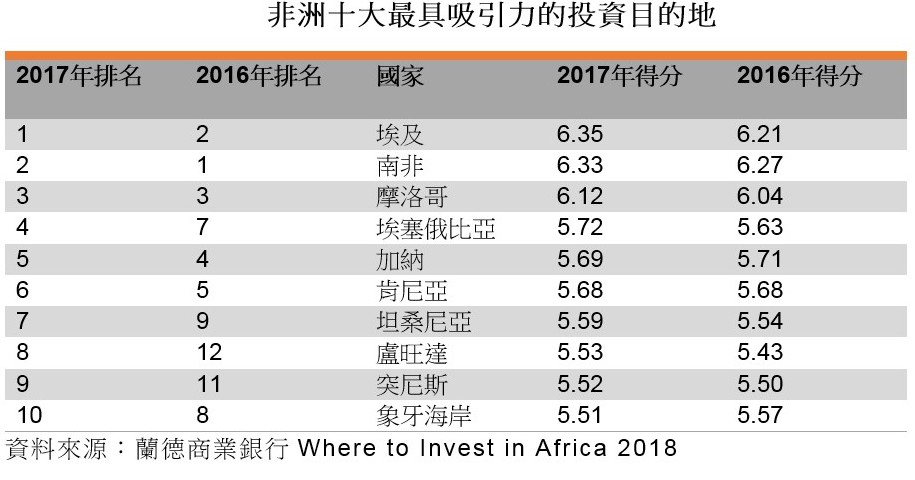
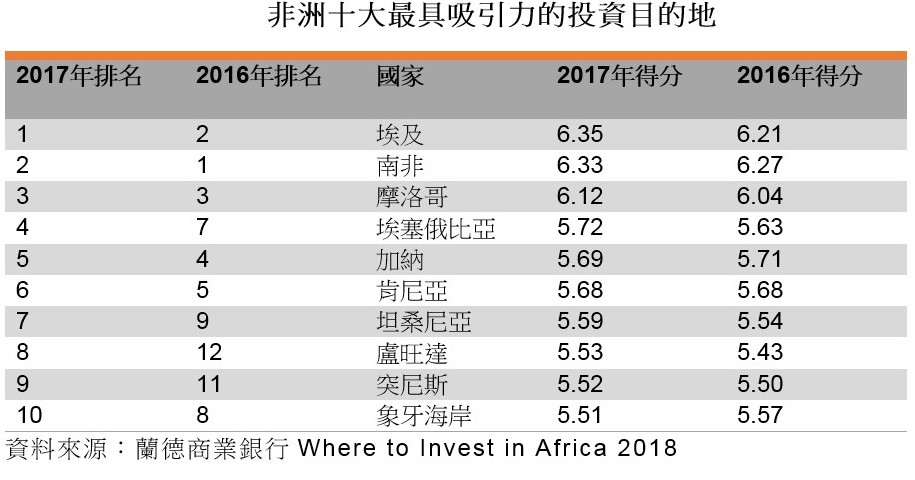
關於這個問題,南非蘭德商業銀行(Rand Merchant Bank)分析師Ronak Gopaldas是個專家,他也是具影響力的Where to Invest in Africa周年報告的合著者之一。2017年底,Gopaldas在湯森路透公司(Thomson Reuters)舉辦的周年非洲高峰會上說:「在非洲市場,經濟不一定跟隨政治。有些非洲國家雖然發生了負面的政治事件,但經濟仍能反彈復甦。這種政治和經濟分離的狀況,在2018年很可能繼續發生。」


 阿爾及利亞


 幾內亞
 蘇丹

 索馬里

 盧旺達

 突尼斯
 塞內加爾

 摩洛哥