




Vietnam
Chinese investment sees Vietnam's first urban railway finally ready to begin commercial operation.
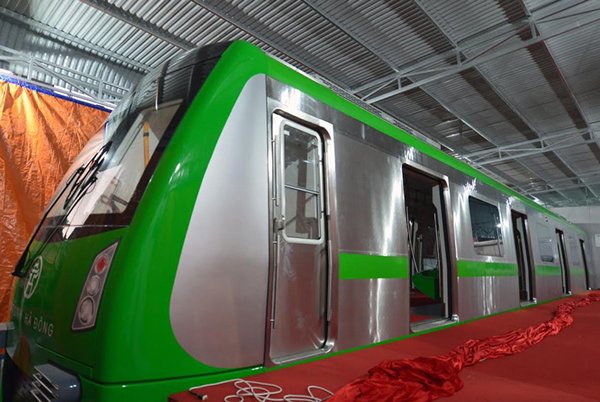
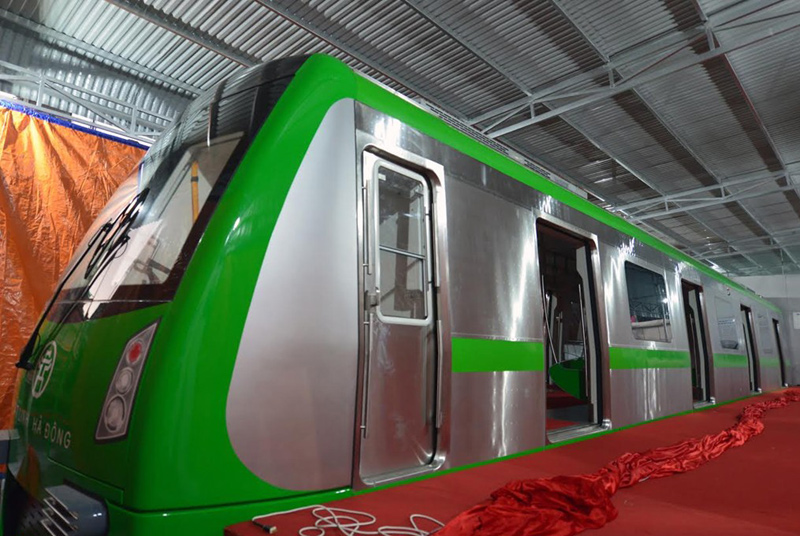
Built by the China Railway Sixth Group Co (CRSG) and forming part of the wider Belt and Road Initiative (BRI), Vietnam's first urban railway – Hanoi's Cat Linh-Ha Dong Elevated Metro Rail Line – is expected to begin commercial operations imminently.
The move follows the successful completion of its initial test runs in August last year, a programme witnessed by local and international stakeholders, as well as representatives of the media. A series of trial passenger runs then followed in October.
The metro link has a total length of about 13km and connects 12 stations across three districts of the Vietnamese capital – Ha Dong, Thanh Xuan and Dong Da. Once fully operational, 13 four-carriage trains will run every two minutes at speeds of between 35 and 80km/h, with the system designed to carry up to 14,000 passengers per hour. The specially-commissioned trains have designated areas for passengers with impaired mobility, seating for the elderly, pregnant women and small children, as well as steel rails to assist standing passengers.
The project was officially launched in 2008, with construction beginning in 2011. In terms of Chinese involvement, in addition to CRSG, the Beijing Mass Transit Railway Operations Corporation also partnered in the development of the scheme. Originally, the project was slated to cost about US$552 million, with Chinese loans covering $419 million of the total. Ultimately, though, costs escalated substantially, with recent estimates putting the final price tag at about $868 million, with the Chinese contribution rising commensurately to $669 million.
It is believed that additional loan negotiations relating to the extra $250 million required to cover the cost overruns delayed the project's completion. Originally, the plan was for the service to commence operation at the end of 2016. In 2017, however, the target date was revised from early 2018 to the end of the same year. By the end of December 2017, however, the final terms of the new loan were agreed and China Eximbank approved the first tranche of the disbursements required to finance the project's completion. Under the new financing agreement, the Vietnamese government will repay the loan over nine years with two payments a year of $14.4 million. This is in addition to the payments outlined under the terms of the original loan agreement.
The new railway forms part of a major initiative by the Vietnamese government aimed at upgrading the country's rail facilities after years of under-investment. Looking at the bigger picture, the Cat Linh-Ha Dong Line – Line 2A – is one of nine lines planned for the nation's capital and forms part of the Hanoi Urban Rail Project, which will involve an estimated spend of $32 billion over the next 30 years. Of that, China has pledged to provide some $11 billion as part of its BRI commitments.
To date, work has only begun on one further route – Line 3. With 12 stations planned along its 12.5km length, the line will connect the city centre-located Hanoi Train Station with suburban Nhon. An 8.5km section of the line will be carried by an overground viaduct, while a further 4km will run underground. Funding has come primarily from France, with the European Investment Bank and the Asian Development Bank also contributing. Construction began in 2014 and the project is scheduled to be completed by 2021.
Beyond the capital, a number of other major rail projects have also been green-lit. Foremost among these are Ho Chi Minh City's metro rail system and a $33 billion link connecting Hanoi and Ho Chi Minh City via a high-speed passenger and freight service. This will replace the single-track, north-south line, which dates back to the beginning of French colonial rule at the end of the 19th century.
To help deliver the massive financing required for these ambitious projects, the Vietnamese government enacted The Law on Railways 2017, which introduced unique preferential mechanisms designed to secure investment in the form of public-private partnership arrangements. Among the incentives on offer are import duty holidays, corporate income tax breaks and concessionary rated land use and loans.
Marilyn Balcita, Special Correspondent, Hanoi
Editor's picks
Trending articles
Mainland and Hong Kong contractors drafted in to steer struggling coal-fired power station developments.

Two of Vietnam's major coal-fired thermal power station projects have been turned over to mainland / Hong Kong developers following fears that local contractors lacked the funds and know-how required to see the initiatives through. With much of the country's power-renewal programme reliant on financial backing funnelled via the Belt and Road Initiative (BRI), relinquishing control of such projects to the primary backers has been widely seen as making sound logistical and operational sense.
The first project to be handed over, in June this year, was the Quynh Lap 1 Power Plant, which was originally being developed by the Vietnam National Coal and Mineral Industries Holding Corporation (Vinacomin), a state-owned mining conglomerate. Responsibility will now fall to Geleximco-HUI, a joint venture between Geleximco, a Hanoi-based investment house, and Hong Kong United Investors (HUI). According to a statement issued by the Vietnamese government, the move follows growing concerns that Vinacomin's position was becoming increasingly untenable, given that the company had debts in excess of VND78 trillion (US$3.4 billion) and a debt-to-equity ratio of 2.5.
The following month, the transfer of the investment rights relating to the Long Phu III Thermal Power Plant was also mooted. Prior to that, the project had been handled by PetroVietnam, the Hanoi-headquartered state-owned oil and gas giant.
While a final decision has yet to be made, a shortlist of two proposed new operators has been agreed upon, both of which are largely China-backed. This sees, in one corner, a consortium of five mainland firms (including Zhejiang Energy International, a Hong Kong-headquartered utility business) and WIN Energy, a Hanoi-headquartered privately-owned power business, squaring up against the China Southern Power Grid Company (CSG), a Guangzhou-based state-owned energy supplier, in the other.
In CSG's favour, it is no stranger to the Vietnamese market. It is already the lead contractor on the $1.75 billion Vinh Tan 1 Thermal Power Project, China's biggest single investment in the country. Due to come online before the end of the year, the project will supply Vietnam's national grid with 7.2 billion KWh on an annual basis once its construction and testing period has been completed. The company already supplies Vietnam with about 33.4 billion kWh of electricity through a number of other, previously delivered projects.
The moves to reallocate responsibility for these projects come at a time when the Vietnamese government has been under increasing pressure from the country's environmental lobby to scale back on its plans for thermal-coal powered plants. Despite the obvious depth of local feeling, ministers have maintained that there is little option but to continue to pursue the current programme.
Defending the government's position, Hoang Quoc Vuong, the Deputy Minister of Industry and Trade, said: "Due to the high costs of renewable energy and the annual 10-15% rise in domestic demand for power that we are continuing to see, we have no choice but to boost the development of the coal-fired power sector.
"While we dearly want to develop renewable energies, that remains a very real challenge. This is largely down to a combination of technical difficulties and a lack of stability with regard to the country's wind and solar power generation facilities."
Of the country's coal-fired projects, China is now by far the largest financier. According to a report by the Green Innovation and Development Centre (GreenID), a Hanoi-based champion of renewable energy, as of the end of 2017, of the country's 27 coal-fired thermopower plants, 14 had been built by Chinese contractors. At the same time, some $8 billion (or 50%) of the total foreign capital flowing into Vietnam's coal-fired thermal power sector was derived from mainland China.
It is also proving harder to find non-mainland based funding for coal-fired electricity-generating projects. Indeed, the London headquartered Standard Chartered Bank is the latest of a growing number of Asia-Pacific-active banks to put a block on coal-related power projects. To date, Singapore's three leading banking groups – DBS, the Oversea-Chinese Banking Corporation and the United Overseas Bank – as well as Japan's Sumitomo Mitsui Banking Corporation, Mitsubishi UFJ Financial Group and Mizuho Financial Group, have all adopted a policy of vetoing such investments.
Marilyn Balcita, Special Correspondent, Hanoi

