









Chinese Mainland
Chinese Outward Real Estate Investment: After the Initial Waves, What's Next?
INTRODUCTION
There has been a tremendous surge in Chinese outward investment in overseas real estate in recent years. What first started as sovereign funds making exploratory investments has proliferated into buying sprees by Chinese developers, banks and institutional investors, such as insurance companies.
This surge has been fueled by a number of key domestic economic and policy factors. We argue that one the most powerful drivers has been the continued consolidation of China’s residential market. Fierce domestic competition, combined with government curbs on home purchases and rising borrowing costs over the past two years, has led to developers’ actively looking elsewhere for new opportunities. Government incentives, such as the relaxation of real estate investment regulations for insurance companies, have also resulted in billions of dollars in extra funding for overseas investment. Meanwhile, mature gateway markets in the UK, US and Australia, with their relatively stable economies, quality products and higher yield returns, continue to attract Chinese investors.
In this report, we focus on these push and pull factors, examining, in particular, issues such as the lasting impact the policy-driven Chinese market will have on outward-looking investors and gateway markets. We also shed light on the next wave of Chinese investors likely to make moves in offshore property markets. In addition we look at the diversification of investors as they move from core and development opportunities into other assets, as well as their move from gateway locations to other higher-yielding cities.

To view the full article, please go to page top to download the PDF version.
| Content provided by |

|
Editor's picks
Trending articles
Kuwait: Heavily Rely on the Oil Sector
Highlights
| Political |
|
| Economic |
|
Country Overview
Kuwait is an Arab country at the tip of Persian Gulf, highly dependent on its oil resources. It has reserves of about 102 billion barrels - more than 6% of world reserves. Oil and gas sector has dominated the economy, making up about 60% of the country’s GDP and about 95% of export revenues. Thanks to its rich oil resources, Kuwait is among the most prosperous country in the world, with GDP per capita exceeding US$40,000. Kuwait has done little to diversify its economy, leaving the country exposed to external conditions. The political turmoil in Iraq and the rise of the extremist jihadi group also represent major concern for Kuwait’s security.
Key Data | |
| Capital | Kuwait City |
| Population | 4.0 million |
| Area |
17,818 sq km |
| Currency | Kuwaiti dinar |
| Official language | Arabic |
| Form of state | Constitutional monarchy |
| Major Merchandise Exports (% of total, 2012) | Major Merchandise Imports (% of total, 2012) |
| Crude oil (93.3%) | Consumer goods (40.0%) |
| Non-oil (6.7%) | Intermediate goods (34.0%) |
| Capital goods (23.0%) | |
| Top three export countries (% of total, 2013) | Top three import countries (% of total, 2013) |
| South Korea (15.1%) | China (11.1%) |
| India (14.1%) | US (10.7%) |
| Japan (10.8%) | Saudi Arabia (8.0%) |
Source: Economist Intelligence Unit (www.eiu.com)
Political Trend
Kuwait is a constitutional monarchy. Although there are no formal political parties, Kuwait has a strong electoral tradition, with a vocal single-chamber parliament made up of 50 members, which can reject government legislation. The current parliament is more balance between supporters and opponents of the government than its predecessor. However, persistent conflicts between the government and parliament could pose larger risks on political stability, and hinder structural economic reforms.
Given Kuwait’s relatively small size, strengthening political and economic ties with its five Gulf Cooperation Council neighbors will remain a key policy objective. Kuwait will seek to continue the policy of building strong bilateral relationships with major Asian powers such as China, Japan, India and South Korea, which are Kuwait’s main trading partners.
Economic Trend
Economic Indicators |
2011 |
2012* |
2013* |
2014^ |
2015^ |
Nominal GDP (US$ bn) |
155.0 |
174.9 |
173.5 |
177.3 |
183.6 |
Real GDP growth (%) |
10.2 |
8.3 |
3.0 |
2.5 |
3.7 |
GDP per capita (USD) |
41,940 |
45,750 |
43,760 |
43,330 |
43,510 |
Inflation (%) |
4.8 |
3.3# |
2.6 |
3.0 |
3.7 |
Budget balance (% of GDP) |
29.8 |
25.9 |
26.0 |
25.1 |
22.4 |
Current account balance (% of GDP) |
43.3 |
45.9 |
40.8 |
37.9 |
34.6 |
External debt/GDP (%) |
24.1 |
20.2# |
19.6# |
18.7 |
19.1 |
#Actual * Estimate ^ Forecast
Source: Economist Intelligence Unit (www.eiu.com)
Kuwait’s oil reserves remain plentiful. It ranks first globally in per capita terms, with about 26,800 barrels per capita. At the current rate of production, proven oil reserves would last about 90 years. Substantial oil revenues have strengthened government finances significantly. Over the past ten years, Kuwait has recorded budget surpluses of 30% of GDP on average, current account surpluses averaged 35% of GDP, reducing the country’s vulnerability to external financial and economic risks to a very low level.
Looking ahead, a gradually rising oil production, and public and private consumption would support a higher growth of around 4% in the near term. However, risks remain predominantly on the downside, given the slower potential growth in advanced economies and emerging markets.
The government has announced a new five-year development plan, for 2015‑19, focusing on economic diversification and the implementation of several strategic mega-projects to boost investment. However, the plan still needs to be passed by parliament. Despite fiscal position is strong, spending rigidities on subsidies and pensions as well as rapid spending increase, which has trebled in the past decade, have also highlighted Kuwait’s fiscal risks.


Hong Kong – Kuwaiti Trade
Kuwait was the 59th largest trading partner of Hong Kong in 2013, the value of Hong Kong exports to Kuwait accounted for 0.05% of Hong Kong’s total trading value. Total exports from Hong Kong to Kuwait increased by 55.1% from HK$1.1 billion in 2012 to HK$1.7 billion in 2013. The top three export categories to Kuwait were: (1) telecommunications, audio & video equipment (+96.0%), (2) office machines & computers (+16.1%), and (3) photographic apparatus, equipment and supplies and optical goods & watches and clocks (+27.8%), which represented 79.8% of total exports to Kuwait.
ECIC Underwriting Experience
The ECIC imposes no restrictions on covering Kuwaiti buyers. Currently, the insured buyers in Kuwait are mainly small and medium-sized companies. For 2013, the number and amount of credit limit applications on Kuwait increased by 3.3% and 11.3% respectively, while insured business rose by 141.7%. Major insured products were jewellery, clothing and electrical appliances, which represented 91.7% of ECIC’s insured business in Kuwait. The Corporation’s underwriting experience on Kuwait has been satisfactory, with no claim payment or payment difficulty case reported from October 2013 to September 2014.
| Content provided by |

|
Editor's picks
Trending articles
Poland: Actively Integrated with EU for Stability
Highlights
| Political |
|
| Economic |
|
Country Overview
Poland is the largest country in Central Europe, in terms of both population and area. The accession to European Union (EU) in 2004 has further integrated its economy with Europe and the rest of the world. Helped by a relatively large domestic market, Poland was the only EU country to have avoided recession during the 2008 global financial crisis. Educated and competent human capital helps attract foreign direct investment (FDI) especially in the automotive, R&D, electronic and chemical sectors. Today Poland has joined the group of countries classified as high-income economies by the World Bank. However, its GDP per capita is at just about two-thirds of the EU average.
Key Information | |
| Capital | Warsaw |
| Population | 38.5 million |
| Area | 312,685 sq km |
| Currency | Polish zloty |
| Official language | Polish |
| Form of state | Parliamentary republic |
| Major Merchandise Exports (% of total, 2013) | Major Merchandise Imports (% of total, 2013) |
| Machinery & transport equipment (34.0%) | Machinery & transport equipment (30.9%) |
| Manufactured goods (19.2%) | Manufactured goods (16.7%) |
| Food & live animals (9.5%) | Chemicals & chemical products (13.4%) |
| Top three export countries (% of total, 2013) | Top three import countries (% of total, 2013) |
| Germany (24.9%) | Germany (26.0%) |
| UK (6.5%) | Russia (10.0%) |
| Czech Republic (6.1%) | Netherlands (5.7%) |
Source: Economist Intelligence Unit (www.eiu.com)
Political Trend
Poland is a parliamentary republic. Parliamentary elections are held at least every four years. After being selected as the next president of the European Council, Donald Tusk resigned from his position of Prime Minister in September, and was succeeded by Sejm speaker Ewa Kopacz.
Major challenge for Kopacz is to reconfigure the party and stitch together from various factions that often compete internally. Meanwhile, balancing the goal of public finance reforms and promoting economic growth remained the government’s priority.
In the wake of the Ukraine crisis, Poland has supported increased sanctions against Russia. Currently, Poland relies heavily on Russian natural gas – about 60% of gas demand has been secured by Russian deliveries. Although energy dependence on Russia is unlikely to be reduced in short term, moves to boost its defensive military capabilities have intensified. In early September, NATO agreed on the deployment of a 4,000-strong rapid reaction force to be based in Poland.
Economic Trend
| Economic Indicators | 2011 | 2012 | 2013 | 2014* | 2015^ |
| Nominal GDP (USD bn) | 514.9 | 489.9 | 517.7 | 541.6 | 539.0 |
| Real GDP growth (%) | 4.5 | 2.1 | 1.6 | 2.7 | 3.3 |
| GDP per capita (USD) | 13,370* | 12,720* | 13,440* | 14,070 | 14,040 |
| Inflation (%) | 3.9 | 3.7 | 0.8 | 0.2 | 1.2 |
| Budget balance (% of GDP) | -5.0 | -3.9 | -4.0 | -3.6 | -3.0 |
| Current account balance (% of GDP) | -5.3 | -3.6 | -1.4 | -1.2 | -1.9 |
| External debt/GDP (%) | 62.3* | 74.6* | 73.0* | 73.1 | 71.7 |
* Estimates ^ Forecast
Source: Economist Intelligence Unit (www.eiu.com)
In Q2 2014, real GDP grew by 3.3% year-on-year, helped by supportive economic policies and improving conditions in main trading partners. However, the relatively swift pace of expansion observed in the first half of the year appears unlikely to be sustained in the second half. The fragile recovery of the euro area, the dampening effect the Ukraine crisis is having on regional activity, as well as the EU-Russia sanctions are all likely to have negative effect on growth in the second half.
In September, annual inflation rate remained negative for three consecutive months, mostly driven by falling food prices as Russian ban on food imports from the EU has created a domestic surplus in Poland. In an attempt to boost the economy and fight off the threat of persistent deflation, Poland’s central bank cut its benchmark interest rate by 0.5% to a record low of 2% in October.
Following Russia’s annexation of territory in Poland's neighbor Ukraine in March, the country’s political leaders had shown greater appetite on the accession to the euro, seeing it as an additional form of security because it would lock the country firmly into Europe's core. In June, Poland’s president, finance minister and central bank governor agreed that the issue of euro entry should be discussed after the general election next year.


Hong Kong – Polish Trade
Poland was the 36th largest export market for Hong Kong in 2013, with exports value accounting for 0.2% of Hong Kong’s total exports. Total exports from Hong Kong to Poland increased by 9.8% from HK$ 5,996 million in 2012 to HK$ 6,585 million in 2013. The top three export categories to Poland were: (1) electrical machinery, apparatus & appliances, & parts (+9.7%), (2) telecommunications, audio & video equipment (+41.9%), and (3) office machines & computers (+70.7%), which represented 64.4% of total exports to Poland.
ECIC Underwriting Experience
The ECIC imposes no restriction on covering Polish buyers. Currently, the insured buyers in Poland range from small and medium sized companies to manufacturing arms of foreign companies. For 2013, the number and amount of credit limit applications on Poland reduced by 6.9% and increased by 32.2% respectively, while insured business decreased by 11.2%. Major insured products were electronics (+78.7%), toys (+8.3%) and clothing (+43.0%), which represented 52.9% of ECIC’s insured business in Poland. The Corporation's underwriting experience on Poland has been satisfactory, with only one claim payment made from October 2013 to September 2014, involving clothing.
| Content provided by |
|
Editor's picks
Trending articles
Turkey: Sacrificing Higher Growth for Lower Deficit
Highlights
| Political |
|
| Economic |
|
Country Overview
Turkey, with a population of around 75 million, is situated at the junction of Asia and Europe. Turkey began to open up the economy in the 1980s, expanding production in the automotive, construction, and electronics industries beyond the traditional textiles and clothing sectors. Over the past decade, GDP per capita has nearly doubled and now exceeds US$ 10,000. Although growth has been promising, Turkey's relatively high current account deficit and its reliance on short-term financing leave the economy vulnerable to capital flows. On-going turmoil in neighboring Syria and Iraq, especially the rapid rise of the extreme jihadi group Islamic State (IS), also represents risk to the country’s stability.
Key Information | |
| Capital | Ankara |
| Population | 75.4 million |
| Area | 783,562 sq km |
| Currency | Turkish lira |
| Official language | Turkish |
| Form of state | Republic |
| Major Merchandise Exports (% of total, 2013) | Major Merchandise Imports (% of total, 2013) |
| Textiles & clothing (18.1%) | Fuel (14.2%) |
| Transport equipment (12.0%) | Chemicals (13.3%) |
| Iron & steel (11.5%) | Machinery (9.3%) |
| Top three export countries (% of total, 2013) | Top three import countries (% of total, 2013) |
| Germany (8.8%) | Russia (10.0%) |
| Iraq (7.4%) | China (9.8%) |
| UK (5.6%) | Germany (9.6%) |
Source: Economist Intelligence Unit (www.eiu.com)
Political Trend
In August 2014, Erdogan became the country's first directly elected president, by winning about 52% of the votes in the first round.
While his supporters say he has improved Turkey's economy and given a political voice to the country's conservatives, his critics accuse him of having Islamist leanings and an autocratic style. Externally, Turkey began accession membership talks with the European Union in 2005. However, progress has so far been limited amid opposition from countries like Germany, fearing that cultural differences will make it difficult to integrate.
Economic Trend
Economic Indicators |
2011 |
2012 |
2013 |
2014^ |
2015^ |
Nominal GDP (USD bn) |
774.6 |
789.1 |
820.1 |
796.6 |
857.6 |
Real GDP growth (%) |
8.8 |
2.1 |
4.0 |
3.0 |
4.0 |
GDP per capita (USD) |
10,470 |
10,560* |
10,880* |
10,480 |
11,180 |
Inflation (%) |
6.5 |
8.9 |
7.5 |
8.9 |
7.4 |
Budget balance (% of GDP) |
-1.4 |
-2.1 |
-1.2 |
-2.6 |
-2.7 |
Current account balance (% of GDP) |
-9.7 |
-6.1 |
-7.9 |
-5.8 |
-6.0 |
External debt/GDP (%) |
39.4 |
42.8 |
47.6 |
48.0 |
44.5 |
* Estimates ^ Forecast
Source: Economist Intelligence Unit (www.eiu.com)
Following a strong rebound in in the aftermath of the global financial crisis, the Turkish economy has been growing at a more moderate pace in recent years. While private consumption remained the major growth engine, high inflation and sluggish wage and employment growth have constrained household spending. In the second quarter of 2014, real GDP growth slowed to 2.1% year-on-year, in the wake of tightening fiscal and monetary conditions. It is expected growth would pick up next year, supported by stronger private consumption and investment.
The country’s chronic current account deficit reflects structural issues related to its heavy dependence on imported energy – almost all oil and gas were imported. Meanwhile, Turkey’s industry imports intermediate goods to produce final goods. The country’s current account deficit could only be narrowed at the expense of higher growth, if a significant change in its trade composition is not to happen. The Turkish government has introduced various measures to address the issue. However, the plan will not have an impact on Turkey’s energy dependency in the short term.


Hong Kong - Turkish Trade
Turkey was the 35th largest trading partner of Hong Kong in 2013, the value of Hong Kong exports to Turkey accounted for 0.2% of Hong Kong’s total trading value. Total exports from Hong Kong to Turkey increased by 6.4% from HK$6.3 billion in 2012 to HK$6.7 billion in 2013. The top three export categories to Turkey were: (1) telecommunications, audio & video equipment (-6.6%), (2) electrical machinery, apparatus & appliances & parts (+2.3%), and (3) Photographic apparatus, equipment and supplies and optical goods, watches and clocks (+19.6%), which represented 55.5% of total exports to Turkey.
ECIC Underwriting Experience
The ECIC imposes no restrictions on covering Turkish buyers. Currently, the insured buyers in Turkey range from small and medium-sized companies to large-scale listed companies. For 2013, the number and amount of credit limit applications on Turkey increased by 10.7% and decreased by 9.4% respectively, while insured business rose by 2.1%. Major insured products were chemical products (+89.6%), electronics (+23.9%) and metallic products (+84.3%), which represented 52.0% of ECIC’s insured business in Turkey. The Corporation’s underwriting experience on Turkey has been satisfactory, with three payment difficulty cases of small amounts reported from September 2013 to August 2014, involving electronics goods and jewellery.
| Content provided by |
|
Editor's picks
Trending articles
Hong Kong Economic Journal - EJ Insight | 12 Jan 2015
India Plans New Industrial Revolution of Its Own
India aims to become a global manufacturing power by focusing on “entirely new industries” such as solar technology, LED lighting, small cars, medical appliances and weapons, Financial Times reported, citing Minister of State for Finance Jayant Sinha.
“What we’re trying to do is massively build out India’s productive capacity,” Sinha told the newspaper in an interview.
“That is, in fact, a veritable supply-side revolution because what we are really trying to do is to position India for a decade or more of sustainable, non-inflationary 7-8 per cent GDP growth. It’s only if we can achieve those kinds of growth rates that we will be able to create the millions and millions of jobs we have to create every year.
India is the world’s third-largest economy after the United States and China, measured on a purchasing power parity basis, but manufacturing makes up only 15 percent of the gross domestic product.
Prime Minister Narendra Modi wants to boost its contribution to 25 to 30 percent of the GDP to help create a million jobs a month in a country with a population of 1.3 billion, the newspaper said.
However, his dream is being hampered by clogged transport infrastructure, a shortage of skills, outdated labor laws that discourage investors, and the reluctance of indebted Indian companies to take on new risks, according to FT.
In order to achieve Modi’s grand vision, the government will seek to meet the country’s vast domestic demand for everything from raw materials to vehicles and home appliances, and then develop internationally competitive industries in new sectors, Sinha said.
“When China became a tremendous electronics manufacturing hub, it did that for smartphones, for instance, which did not exist as a product category,” Sinha said. “It did that in laptops, which did not exist as a product category. They didn’t necessarily replicate what Japan was doing in automotive manufacturing.
“Similarly, I think there will be industries where India will become a global leader, but those are entirely new industries, for instance solar appliances, solar lanterns, solar home systems . . . India is already the world hub for small car design and manufacturing.”
Sinha added: “The Indian economic model is not the same as the Chinese economic model. Ours is a much more innovation-driven, bottom-up approach towards economic growth . . . We will rely on our innovative and world-class firms to be able to unlock these new manufacturing industries of the future.”
The first stage of India’s planned industrial revolution is likely to put more emphasis on public spending for infrastructure than on private investment in new factories.
The government plans to boost public investment by US$25 billion to US$50 billion in the 2015-16 fiscal year, while the country’s railway network seeks to invest US$100 billion in the next five years.
Energy Minister Piyush Goyal has launched a US$250 billion plan for power generation and transmission to double electricity output and achieve Modi’s promise of 24-hour electricity for all by 2019, the report said.
Full content of EJ Insight is available at www.ejinsight.com. Copyright Hong Kong Economic Journal Ltd. Republishing and editing are forbidden without authorization from Hong Kong Economic Journal. If there are any questions, please contact Chris Yeung (chrisyeung@hkej.com) for editorial matters and Margaret Lor (margaretlor@hkej.com) for sales and marketing matters.
| Content provided by |  |
Editor's picks
Trending articles
What is a DTA and how does it work?
What is a DTA and how does it work?
DTA is short for double tax agreement. It is also called double tax treaty (DTT). Countries or states sign DTA’s in order to achieve the following major objectives: avoidance of double taxation, allocation of taxing rights, and exchange of information. DTA’s are negotiated bilaterally between two states and drafted by reference to the framework under the OECD Model Tax Convention.
(I) Avoidance of double taxation
A person earning an income is subject to tax in the state of which he is a resident. Alternatively an income may be taxable in the state in which the income generating activity takes place. But by the operation of the domestic tax rules, the income taxed in one state may also be taxed again in another state. Double taxation may arise in any one of the following three ways:
(a) the conflict of rules adopted by different countries in the determination of tax residence;
(b) the conflict between residence rule in one country and source rule in the other country, and
(c) the conflict of rules adopted by different countries on the source of income.
Example - 1
A Hong Kong company assigns a US national, whose wife and kids are working and living in Canada, to work for its subsidiary in Shanghai for two years. In the absence of any DTA signed between respective countries, the same income of the employee may become taxable in four jurisdictions.
First, double taxation arises from the conflicts between residence rules. The above employee is both a tax residence of Canada and the US as per residence rules of each country. One the one hand, the employee suffers income tax due to his family ties with Canada. That is, his family members work and live in that country. On the other hand, he is a tax residence of the US that imposes worldwide tax on its nationals. Second, double taxation arises from the conflict of source rules between Hong Kong and China. The above employee is subject to income tax as he exercises employment in China, while he is also subject to salaries tax in HK because a contractual relationship has been created following the employment agreement concluded between him a HK company. Third, double taxation arises from the conflict between the residence rules and source rules. Where the employee is taxed in Canada because he has family ties with the country, the same income is subject to tax in China because the employee is performing his duty in China.
(II) Allocation of taxing rights between the signing states
(a) Assignment from HK to China
Let’s study the first example on how the problem of double taxation is solved.
In respect of the double tax claims by the US and Canada, the employee of the HK employer can refer to the Article 4 in the US-Canada DTA to solve the dual residence issue. According to the US-Canada DTA, the employee’s personal and economic relationship (the center of vital interest) with Canada shall take precedence over his US nationality in the determination of residence. In respect of the double tax claims by Canadian and Chinese tax authorities, the employee can avoid double tax as he is entitled under Article 21 of Canada-China DTA to the tax credit in Canada for tax paid to the Chinese tax authority on the income earned in China. Article 21 of Canada-China DTA operates to solve the residence-source conflict. In respect of the double tax claims by the tax authorities in HK and China, the employee can avoid the double tax arising from the clash in source rules by submitting an application for a tax exemption in Hong Kong on the strength of the taxes he has suffered and paid in China on the same income.
(b) Presence of employees in the host country
A double tax agreement can resolve the issue whether certain activities performed in one contracting state (country) by the employees of a company in the other contracting state, has created a taxable presence in the latter state. That is, whether the former has a permanent establishment in the latter.
Example - 2
An employee of a Japanese company is assigned to work in China continuously in connection with an engineering project of the PRC subsidiary for a period of 180 days.
There is a double tax problem, and the respective taxing rights of Japan and China are allocated in one of the following ways:
(i) As per DTA between Japan and China, the presence of employee does not create a permanent establishment in China if the following conditions are met: the employee stays in China for a period not exceeding 183 days in any 12-month period; and his income is not paid or borne by the PRC subsidiary. In this case, China does not tax the income; or
(ii) The presence of employee does create a permanent establishment in China where the parent company charges back the employee’s salaries to the PRC subsidiary. In this case, China taxes the income.
(c) Unilateral tax adjustment
Example - 3
A holding company in country A, in order to reduce its taxable income, purchases goods from its subsidiary in country B at a unit price of USD10, which is above the arm’s length price of USD6. The tax authority later adjusts the purchase price from USD10 to USD6 following the completion of a transfer pricing audit. The group as a whole will be subject to double tax of USD4 per unit of the goods sold, in the absence of a corresponding downward adjustment of the selling price for the subsidiary in country B.
To avoid the double taxation arising from a price adjustment, states may adopt article No. 9 (associated enterprise) of the OECD model tax convention, which provides that the other state shall make adjustment accordingly.
(III) Exchange of information
The exchange of information (EOI) article is provided with an aim to the prevention of fiscal evasion on income and capital, which also deals with double non-taxation of income that arises from the interaction of domestic tax rules of two or more contracting states. Specifically the EOI article operates to override the personal scope (Article 1) and taxes covered (Article 2) as provided in the OECD Model Tax Convention.
(a) Foreseeable relevance
The tax authorities of the contracting state shall exchange such information as is foreseeably relevant for carrying out the provisions of the DTA or to the administration or enforcement of the domestic laws of the contracting states concerning taxes covered by the DTA.
The EOI article is not subject to restriction by the personal scope under Article 1. The scope of information to be exchanged shall include the information in the possession or under control of a person located in the state of the requested authority, who may or may not be the tax resident of either state.
(b) Secrecy provision
Information shall be disclosed only to persons or authorities (including courts and administrative bodies) concerned with the assessment or collection of, the enforcement or prosecution in respect of, or the determination of appeals in relation to the taxes referred to in paragraph (a).
(c) Limitation to relevance and secrecy
The relevance and secrecy provisions are subject to restriction in the following way such that there is no requirement to (i) carry out administrative measures at variance with the laws and administrative practice, (ii) supply information not obtainable under the laws or in the normal course of the administration, of that or of the other contracting state, and (iii) supply information which would disclose any trade secret or process, or information the disclosure of which would be contrary to public policy.
Notwithstanding the provisions in the preceding paragraph, the requested state should not refuse to do so even if the information is not relevant or needed in the assessment, collection or enforcement of the taxes at home. Equally, the requested state cannot decline the requesting state on ground that the information is held by banks, nominees, persons acting in an agency or fiduciary capacity, or it relates to ownership interests in a person.
(IV) Definition of a person
The scope of a person is different between the avoidance of double taxation on income and exchange of information under the DTA articles. A person for purposes of (I) and (II) includes a natural persons and legal persons, who are the residents of one or both contracting states. A person for purpose of (III) includes the taxpayers and non-taxpayers, who reside or are present in the state of the requested authority.
| Content provided by |

|
Editor's picks
Trending articles
Update on the Hong Kong-Germany Double Taxation Agreement
We were recently invited to a high level discussion on the planned Double Taxation Agreement (DTA) between Hong Kong and Germany, an important topic for many of our readers. Organised by the German Consulate General in Hong Kong, the event brought together a hand-selected group of business leaders, representing German companies’ interests, and representatives of the German Federal Ministry of Finance. The aim of this meeting was to create an open forum for ideas exchange and feedback relating to the pending DTA. In particular, it was an opportunity to share with the Federal Ministry of Finance any concerns or advice that German companies may have regarding the DTA.
History
Hong Kong already has comprehensive DTAs in place with 32 countries, including Austria and Switzerland. A first round of discussions began in early 2014 to put in place a full-fledged DTA with Germany. The second round of negotiations are concluding today in Hong Kong and if successful, will still be subject to ratification. According to the German Federal Ministry of Finance, the aim of the DTA between Hong Kong and Germany is two-fold: “desiring to further develop their economic relationship, to enhance their cooperation in tax matters and to ensure an effective and appropriate collection of tax,…” and “intending to allocate their respective taxation rights in a way that avoids both double taxation as well as non-taxation...”
What the DTA means for German businesses
- Since several other major European countries have already signed a DTA with Hong Kong, Germany is currently at a disadvantage. Moreover, for Hong Kong to remain a competitive location vis-à-vis other countries such as Singapore, which already have agreements in place with Germany, a DTA would be beneficial.
- A DTA would help with cross-border tax transparency for German citizens with assets at home and abroad.
- In our opinion, a DTA with Germany would only strengthen Hong Kong’s standing as an attractive city for German businesses and individuals. Hong Kong is the gateway to China and Asia, offering a low tax regime, access to international capital markets, and its status as a RMB and transport hub. This, in combination with its sound rule of law and stable financial system, gives the city a distinct advantage over others. A DTA with Germany will only reinforce this standing.
| Content provided by |

|
Editor's picks
Trending articles
Effects of CNH Exchange Rate on Offshore RMB Interest Rate
Since November 2014, the exchange rate of offshore RMB to USD (CNH exchange rate) has depreciated while choppy CNH HIBOR led to a significant increase in capital cost. This article will discuss whether this phase of RMB interest rate fluctuation has a causal relationship with the depreciation of RMB and the dynamics of such relationship.
Effects of different sources of funds in offshore markets on RMB interest rates
Interest rate is the cost paid by those who demand capital. Hence, in order to answer the first question, we have to understand the channels for obtaining RMB capital in the offshore market and their impact on interest rates.
Unlike onshore parties who gain liquidity mainly from repurchase agreement (Repo) and the interbank market, parties in the offshore market gained RMB liquidity from the following three ways, namely, CNH swaps, interbank lending and CNH CCS. These three channels have different impacts on offshore RMB interest rates.
CNH swap refers to the use of foreign currency (mainly USD) to swap with RMB, which is similar to using USD as collateral for RMB loans. Currently, RMB swaps average approximately USD 20 billion in daily trading volume, much higher than that of interbank lending (on average USD 5-8 billion per day), and are the main channel for obtaining capital in the offshore RMB market. The “CNH Implied Yield” from CNH swap trading has also become the unofficial benchmark rate in the offshore RMB market.
Interbank lending requires the lender to pre-approve a credit line to the borrower in advance. Since such lending is essentially unsecured loans, there are certain requirements for participating institutions, limiting the capital pool available for interbank lending. Therefore, interbank lending is not as active as CNH swaps. One should also note that the quotations of offshore interbank lending are calculated mainly using CNH Implied Yields of the corresponding tenor. Therefore, price changes in offshore RMB capital will first be reflected in CNH Implied Yield and then be transmitted to interbank lending rates. As shown in the diagram below, CNH Implied Yield and CNH HIBOR Fixing are closely correlated, but the latter one is a bit less choppy as it is merely a daily fixing rate and does not represent actual market transactions.

To view the full article, please go to page top to download the PDF version.
| Content provided by |

|
Editor's picks
Trending articles
Mergers and acquisitions: Cultural alignment for successful integration
Cultural alignment is a prerequisite, opportunity, and challenge for directors and CFOs to create value and synergies in post-merger integration
Too often companies put together matches look great on paper but are fraught with management and structural problems that end up turning deals into busts. Acquiring companies often underestimate the problems that unalike company cultures can inflict on a merger. In fact, the difference between success and failure of deal-making is often not a matter of strategy or money, but rather of relationships, culture and politics.
Putting two companies together normally gives the combined entity the resources and capabilities to compete with the market giants. It would also create dominant positions in many markets around the world. However, that was not the case for advertising giants Publicis Groupe SA and Omnicom Group Inc. After the merger, the two CEOs, Publicis’s Maurice Lévy and Omnicom’s John Wren, agreed to be co-CEOs for 30 months; while that sounded good, the reality was that they couldn’t agree on a management team, the way of splitting their duties, or even on which firm should be listed as the acquirer from an accounting perspective. The deal was eventually scuttled in 2003.
The challenge of putting the companies together can be further exacerbated if the two companies have vastly different business models and cultures. For example, in Valeant Pharmaceuticals’s long-running hostile takeover campaign of Allergan Inc., the Botox-maker, the company executives of Allergan have expressed their disagreement with Valeant’s proposal to slash the amount of money that the company spends on research, a move that would probably lead to layoffs of hundreds or even thousands of its employees. As such, Allergan has disregarded Valeant Pharmaceuticals’s proposal and instead, agreed to be sold to generic pharmaceutical manufacturer Actavis plc., a company that shares similar values.
How cultural issues affect the success of an M&A transaction
Integration can be defined in general terms as the process of combining two companies into one entity at every level. Post-merger integration, the most often-cited concern that could significantly impact the success of an M&A transaction, is the top concern for directors and CFOs. Post-merger integration has to be multi-dimensional, with inputs from various perspectives, including strategy, new management, organisation, business, finance and accounting, tax and legislation, information system, and human resources. Yet, studies have pointed out that plenty of M&A transactions fail to yield desired expectations or even erode shareholder value. The little secret about M&As is that the human dimensions and culture are at least as important, if not more critical, than the strategy, pricing, and positioning. Cultural unfitness is commonly found to have a direct and indirect linkage to integration failure. Unsuccessful cultural integration could lead to organisation distractions, loss of key talents, and failure to achieve critical milestones or synergies.
Cultural integration is the key to a successful merger
Many studies agree that cultural alignment is critical to a successful merger. Yet, due to the intangible nature of culture and time constraints, management would rather focus on things that are tangible and measurable, such as financial data and legal matters. Cultural integration is then left unattended and postponed to the post-deal phase. Nevertheless, culture is not something that can be changed or integrated without well-organised plans; it requires time and attention to bring two cultures together and blend into a new collaborative environment.
Approaches to cultural integration
So, how can two different cultures be integrated to achieve full value? First of all, we have to understand the term ‘culture’. Corporate culture is the beliefs and behaviours that determine how a company’s management and employees interact and handle outside business transactions. Often, corporate culture is implied, not expressly defined, which develops organically over time from the cumulative traits of the people that the company hires. A company’s culture can be reflected in its dress code, business hours, office setup, employee benefits, turnover, hiring decisions, client satisfaction and other operational aspects. No companies are cultural twins and thus careful attention is required in understanding the cultures of both merging companies and managing the cultural integration process.
Having said that, it is highly recommended to start the cultural assessment early and make sure that the human dimensions of the combination are incorporated into your due diligence and integration planning from the beginning, instead of an afterthought. Organisations can start with cultural assessment during the due diligence stage, which provides preliminary indications on cultural alignment or misalignment of the two merging companies and whether the existing cultures can be aligned with the overall business strategy. With the cultural and strategic alignment assessments, organisations can reach a tailored sale and purchase agreement and formulate integration strategies that facilitate smoother transition and more effective integration to capture post-merger synergies. The time spent on cultural assessment needs not to be long but should be good enough to obtain a basic understanding on the cultural and strategic background of both companies.
Second, more time should be spent on development and management of the action plan. Due to its intangible nature, culture-related issues are likely to be unpredictable and thus addressing the issues can be a challenging task for the management. In most M&A transactions, companies focusing on cultural integration tend to achieve post-merger synergies – apart from analysis of cultural differences, those companies also evaluate the cultural opportunities and obstacles, which guide their efforts to the right directions. The companies would also take initiatives in redesigning the organisational structure, determining leadership assignment, and modifying human resources practices such as compensation and benefits.
This is followed by communication to employees regarding the company’s new directions and meaning of the changes. Changes may create frustration and stress to employees, yet proper communication from management with a clear vision for the integration can relieve scepticism and doubt. Accompanying with employees retention strategies and other team building activities, companies can establish a new culture and concentrate on the post-merger business goals.
Potential value of cultural alignment
“People are valuable assets to an organisation and play an integral part to the success of a business. Effective people management is the key to achieving post-merger synergies so as to maximize the optimal outcome,” says Barry Tong, Transaction Advisory Services Partner of Grant Thornton Hong Kong. As cultural integration is one of the key factors of a successful merger, it is important to have a dedicated team to manage and oversee the whole integration process.
The causes of merger failure can be complex and varied case-by-case, and there is no perfect model to apply. Nonetheless, culture misalignment is commonly considered as a direct and indirect hurdle and mismanagement of any cultural unfitness can hinder the company from realizing synergies during the integration process. Cultural and strategic alignment, active management of cultural integration, as well as proper communication between management and employees, are the suggested measures that ensure smooth cultural integration and contribute to a successful merger.
Conclusion
Cultural compatibility can have significant impact on the ultimate success of an M&A transaction. It is suggested that a separate cultural integration plan be studied, created and worked upon in the early stages of a merger. Proper management of cultural issues is the key to realise successful post-merger integration, especially from a people perspective.
| Content provided by |

|
Editor's picks
Trending articles
"One Belt, One Road" Initiative: The Implications for Hong Kong
The “One Belt, One Road” Initiative – the Silk Road Economic Belt and the 21st Century Maritime Silk Road – is key part of China’s development strategy. The Vision and Actions on Jointly Building the Silk Road Economic Belt and the 21st Century Maritime Silk Road (the “Vision and Actions”) issued by the National Development and Reform Commission on 28 March 2015 outlines the initiative’s framework, co-operation priorities and co-operation mechanisms.
The Belt and Road Initiative aims to promote connectivity in infrastructure, resources development, industrial co-operation, financial integration and other fields along the Belt and Road countries. These strategic objectives are also closely connected to the “going out” strategy of many Chinese businesses. In light of the Vision and Actions document, as well as other related information sources, the “One Belt, One Road” initiative, with its extensive reach across a number of regions, represent clear development opportunities for Hong Kong.
Vision and Actions: The Key Points
The “One Belt, One Road” initiative aims to promote “connectivity in five respects”: policy co-ordination, facilities connectivity, unimpeded trade, financial integration and people-to-people bonds. These may be summed up as follows:
The Silk Road Economic Belt focuses on bringing together China, Central Asia, Russia and Europe (the Baltic); linking China with the Persian Gulf and the Mediterranean Sea through Central Asia and West Asia; and connecting China with Southeast Asia, South Asia and the Indian Ocean. The 21st Century Maritime Silk Road is designed to go from China’s coast to Europe through the South China Sea and the Indian Ocean and from China’s coast through the South China Sea to the South Pacific. On land, the initiative will take advantage of international transport routes, rely on core cities along the Belt and Road, and use key economic and trade zones and industrial parks as co-operative platforms. At sea, it will focus on jointly building smooth, secure and efficient transport routes, connecting major seaports along the Belt and Road.
Facilities connectivity: Priority will be given to removing transport bottlenecks and promoting port infrastructure construction and co-operation in order to deliver international transport facilitation. Priority will also be given to the construction of regional communications trunk lines and networks in order to improve international communications connectivity.
Economic Corridors of the “One Belt, One Road”
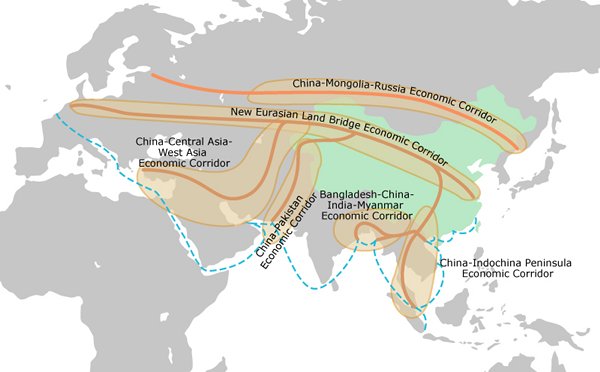
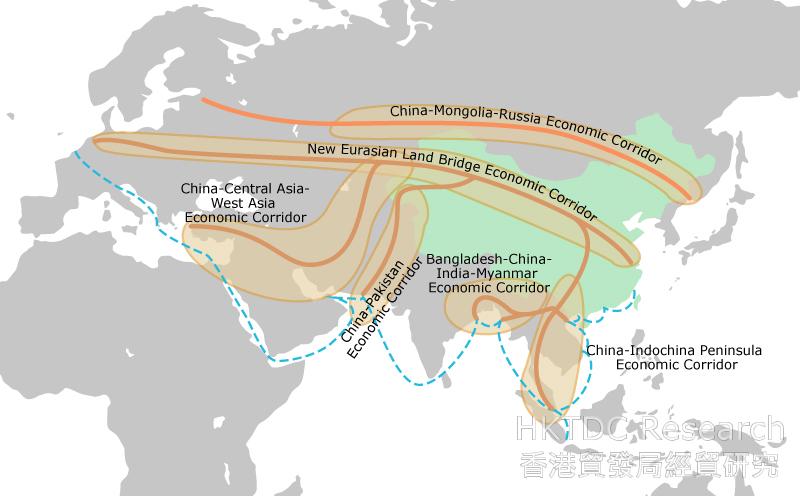
Investment and trade co-operation: Efforts will be made to resolve the problems of investment and trade facilitation; hold discussions on opening free trade zones; expand traditional trade and develop modern service trade and cross-border e-commerce; promote trade through investment, strengthen co-operation with relevant countries in industrial chains, promote upstream-downstream and related industries to develop in concert, and build overseas economic and trade co-operation zones; and encourage Chinese enterprises to participate in infrastructure construction and make industrial investments in countries along the Belt and Road.
Financial integration: Efforts will be made to promote the development of the bond market in Asia and push forward the establishment of the Asian Infrastructure Investment Bank, the BRICS New Development Bank and the Silk Road Fund; support the efforts of Belt and Road countries and their companies/financial institutions in issuing RMB bonds in China; encourage Chinese financial institutions and companies to issue bonds denominated in both RMB and foreign currencies outside China; give full play to the role of the Silk Road Fund and that of sovereign wealth funds of the Belt and Road countries, and encourage commercial equity investment funds and private funds to participate in the construction of the key projects of the initiative.
People-to-people bonds: Efforts will be made to strengthen educational and cultural co-operation, including cross-nation student and education exchanges; enhance co-operation in tourism; and support think tanks in the Belt and Road countries to jointly conduct research and hold forums.
Fully leverage the comparative advantages of various regions in China:
Northwestern and northeastern regions: The initiative will give full scope to Xinjiang’s geographical advantages and make it a core area on the Silk Road Economic Belt, while giving full scope to the advantages of Inner Mongolia and Heilongjiang province with regard to their proximity to Russia and Mongolia, as well as improving the rail links connecting Heilongjiang with Russia.
Southwestern region: The initiative will give full play to the unique advantages of Guangxi and Yunnan, speed up the opening up and development of the Beibu Gulf Economic Zone and the Zhujiang-Xijiang Economic Zone (also known as the Pearl River-Xijiang Economic Zone), and develop a new focus for economic co-operation in the Greater Mekong Sub-region.
Coastal regions and Hong Kong, Macau and Taiwan: The initiative will support the Fujian province in becoming a core area of the 21st Century Maritime Silk Road; give full scope to the roles of Qianhai (Shenzhen), Nansha (Guangzhou), Hengqin (Zhuhai) and other locations in opening up and co-operation, and will help to build the Guangdong-Hong Kong-Macau Big Bay Area; will strengthen port construction in a number of coastal cities, such as Shanghai, Tianjin, Ningbo-Zhoushan, Guangzhou, Shenzhen, Zhanjiang, Shantou, Qingdao, Yantai, Dalian, Fuzhou, Xiamen, Quanzhou and Haikou, and will strengthen the functions of several international hub airports, notably Shanghai and Guangzhou.
Inland regions: With a focus on city clusters along the middle reaches of the Yangtze River and around Chengdu and Chongqing, the initiative will establish Chongqing as an important pivot for developing and opening up the western region, while making Chengdu, Xian and Zhengzhou leading areas for opening up in the inland regions, and developing railway transportation in the China-Europe corridor.
Co-operation mechanisms and platforms: The initiative will make full use of existing multilateral co-operation mechanisms, such as the Shanghai Co-operation Organisation (SCO), ASEAN Plus China (10+1), Asia-Pacific Economic Co-operation (APEC), Asia-Europe Meeting (ASEM). In addition to existing forums and exhibitions, it is also proposed that an international summit forum on the Belt and Road Initiative should be established.
Infrastructure: Taking Precedence in the “One Belt, One Road” Initiative
The Asian Development Bank estimated that the Asian economies would need to invest US$8 trillion in infrastructure to bring their facilities up to average world standards between 2010 and 2020. According to reports, China is conducting feasibility studies on four outbound high-speed railways, including the Europe-Asia high-speed rail, the Central Asia high-speed rail, the Pan-Asia high-speed rail and the China-Russia-America-Canada line. The domestic sections of the first three projects are reportedly underway, while negotiations are still being carried out on the last project, as well as on the overseas sections of the first three projects.
Apart from railway networks, other cross-border projects and the building of port facilities, airports, highways, and even electricity and communications projects in the Belt and Road countries are also targets for China’s “going out” funds. In addition to investment, there will also be a considerable number of opportunities for the international contracting of construction and machinery exports.
Industrial Co-operation: Stimulating Trade Flows
In terms of resource development, several provinces in China are planning to take advantage of the Belt and Road Initiative in order to encourage competitive industries to go global and undertake co-operation in advanced technologies. Chinese enterprises are also being encouraged to increase overseas investment in the exploitation of mineral resources in order to improve China’s supply of energy resources.
According to the Department of Outward Investment and Economic Co-operation of the Ministry of Commerce, China has established 118 economic and trade co-operation zones in 50 countries around the world. (These are set up in the host countries, with Chinese enterprises forming the mainstay based on the market situation, the investment environment, and the host government’s policies when it comes to managing investment to attract enterprises to set up production there.) Of these zones, 77 are established in 23 countries along the Belt and Road. These overseas economic and trade co-operation zones have become China’s platforms for overseas investment co-operation, as well as platforms for the clustering of industries.
There are 35 co-operation zones in countries along the Silk Road Economic Belt, including Kazakhstan, Kyrgyzstan, Uzbekistan, Russia, Belarus, Hungary, Romania and Serbia. There are also countless economic and trade co-operation zones along the 21st Century Maritime Silk Road. There are, for example, Chinese industrial parks in Laos, Myanmar, Cambodia, Vietnam, Thailand, Malaysia and Indonesia, and in South Asia, as well as even in Pakistan, India and Sri Lanka. The Belt and Road Initiative, then, will generate more development opportunities, including the building of industrial parks, facilitating investment projects and boosting international trade by the private sector.
Supporting Development Through Financial Co-operation
In order to provide financial support for the development of the Belt and Road Initiative, China is actively promoting the establishment of the Asia Infrastructure Investment Bank, the BRICS New Development Bank and the Silk Road Fund. The Silk Road Fund was officially established at the end of December 2014. According to Silk Road Fund chair, Jin Qi, the fund will mainly invest in infrastructure, energy development, and industrial and financial co-operation, and will support the export of high-end technologies and production capacity. The Belt and Road Initiative does not have strict geographical boundaries and the fund will participate in any project relating to connectivity.
The Silk Road Fund may set up sub-funds for investment in particular industries. Some of these sub-funds may have particular industries as entry points. For example, an electricity sub-fund may be established as many companies may choose to invest in electricity projects. Another sub-fund may target particular regions. Where there are enough qualified people well familiar with a particular region, a sub-fund may be established for that region.
According to Zhou Xiaochuan, Governor of the People’s Bank of China, the Belt and Road Initiative will generate development and investment opportunities as it has diverse financing needs, with the role of the investment bank being to match investment demand and supply through proper financial arrangements. In terms of the demand for qualified personnel, Zhou said that staff members must have experience in investment and international exposure, in addition to a sound understanding of particular countries. They must also have expertise and social connections, together with an engineering background (especially in financing for engineering projects), possess considerable knowledge or experience in key industries, and speak a relevant foreign language.
Driving Increased Levels of Domestic Investment
Chinese provinces are responding positively to the Belt and Road Initiative. According to reports, as of 5 February 2015, more than two-thirds of the 28 mainland provinces that had held their local people’s congresses and political consultative conferences have made their own plans for the initiative. In infrastructure planning, for instance, Chongqing has issued its Opinions on Implementing the Belt and Road Strategy and Building the Yangtze Economic Belt and is expected to invest Rmb1.2 trillion in infrastructure before 2020. This will generate opportunities for co-operation in construction, planning, management, finance and other related fields.
Implications for Hong Kong
In terms of industry sector, infrastructure may be the first stage in the development of the Belt and Road Initiative. It requires investment, project contracting and will drive demand for relevant services. In this connection, Hong Kong should be able to find a considerable array of opportunities in financing, project risk/quality management, infrastructure and real estate services (IRES), as well as several other related fields.
A number of Chinese enterprises may become involved in mergers and acquisitions in the course of “going out”. According to some analysts, China’s aviation industry should also plan to “go out” through mergers and acquisitions. To date, Hong Kong has been the key platform for the mainland’s outward investment. By the end of 2013, Hong Kong accounted for 57.1% of China’s outward investment stock, with the cumulative value standing at US$377.1 billion. The increase of investment and merger and acquisition activities will increase the demand for the respective professional services in Hong Kong.
The launch of the Belt and Road Initiative will increase people-to-people exchanges between China and the countries concerned, as well as boost demand for international logistics. Hong Kong has a leading edge in global logistics links and operation. In addition to freight services, Hong Kong can give further leverage to its functions as a maritime services centre. As Nansha in the Guangdong Free Trade Zone also intends to develop maritime services, Hong Kong may explore co-operation possibilities with the district.
Another area in which Hong Kong can play a substantial role is financial services. Hong Kong can provide additional services here, including fund raising, financing, bonds, asset management, insurance and offshore RMB business. Hong Kong can also seek to play a bigger role in the Asian Infrastructure Investment Bank, BRICS New Development Bank and Silk Road Fund, including encouraging these institutions to set up their headquarters and branches in the territory and make greater use of Hong Kong’s international talent, as well as inviting the Silk Road Fund to set up sub-funds in Hong Kong. In addition, passenger and freight transport, aircraft leasing and other aviation-related financial services also represent a considerable number of opportunities.
In terms of industrial co-operation, China’s overseas economic and trade co-operation zones will become platforms for overseas investment and co-operation for Chinese enterprises, as well as platforms for the clustering of industries. Southeast Asia, South Asia and Central Asia may further develop into a more extensive network of bases for industrial relocation and even open up as consumer markets. The demand for logistics, supply chain management, consumer products and services may increase with the growth of these regions. Following the opening of logistics hubs in Central Asia, there will be railways linking China with the region. For example, Hong Kong businesses may consider using the Chongqing-Xinjiang-Europe railway to transport goods directly from Chongqing to the Central Asian market, thus saving time and money.
With regard to regional development, apart from Southeast Asia, South Asia, and even Central Asia, Central and Eastern Europe, the demand of mainland provinces for infrastructure investment and logistics services in support of the Belt and Road Initiative will also generate business opportunities for the relevant industries.
Hong Kong can also play a more proactive role in the Belt and Road co-operation platform. For example, Hong Kong may strive to regularly host international summits/forums and work with think tanks and cultural and educational institutions in the Belt and Road countries in conducting research, training, co-operations and exchanges. It could also act as a platform for personnel exchanges/training in relevant fields, such as logistics, infrastructure and finance.
| Content provided by |

|