









Chinese Mainland
HKTDC Research | 11 Nov 2015
Belt and Road Initiative Spurs China's Outward Investment Programme
China is now the world’s third largest source of foreign direct investment (FDI). In recent years, the Chinese government has substantially relaxed the relevant administrative measures for dealing with overseas investments and introduced the Belt and Road development strategy in order to strengthen economic co-operation with the regions concerned. In light of this, China's level of outward investment will further expand, while its investment in countries along the Belt and Road is expected to show sustained growth.
Hong Kong is the preferred services platform for China’s outward investment activities and has provided a full range of professional services for mainland enterprises looking to invest abroad. In particular, it has specialised in providing assistance in the areas of finance, law, tax, the risk assessment of sustainable operations, and international testing and certification, among others. As the mainland accelerates the pace of its “going out” activities and advances the Belt and Road initiative, more business opportunities will inevitably become available to services practitioners in Hong Kong.


Outward Investment on a Steady Rise
China’s overseas investment activities have continued to grow in recent years, making the country one of the leading sources of global FDI. According to the latest figures from the United Nations Conference on Trade and Development (UNCTAD), China’s total outward FDI rose from about US$101 billion (US$107.8 billion, according to China) in 2013 to an estimated US$116 billion [1] in 2014 (US$123.1 billion, according to China), placing it behind only the US and Hong Kong [2]. This has made China the world’s third-largest source of FDI for three consecutive years, starting from 2012.


In recent years, China has substantially relaxed its outbound investment management procedures and actively built platforms to help more businesses in order to “go out” and co-operate with foreign partners to transform and upgrade themselves. In particular, the resolution adopted by the Third Plenary Session of the 18th CPC Central Committee at the end of 2013 proposed that, in order to meet the needs of economic globalisation, China should continue opening up both internally and externally and combine the strategies of “going out” to invest overseas with “bringing in” the advantages of foreign partners to achieve the most effective allocation of international and domestic resources.
The National Development and Reform Commission (NDRC) subsequently issued the Administrative Measures for the Approval and Record Filing of Outbound Investment Projects. This greatly narrows the scope of investment requiring the approval of the departments concerned. As of May 2014, general outbound investment projects with an investment level of less than US$1 billion only require filing in terms of a record being kept. At the end of 2014, the NDRC announced the scrapping of approval for general outbound investment projects with an investment of more than US$1 billion (except for projects involving sensitive countries, regions and sectors) [4]. Since then, record filing has replaced approval for all general outbound investment projects, unless those involve sensitive countries, regions or sectors.
Belt and Road: A Long-term strategy and a Boost to Investments
China is now promoting the Belt and Road initiative, an external development strategy centring on the Silk Road Economic Belt and the 21st Century Maritime Silk Road. In March 2015, China issued Vision and Actions on Jointly Building the Silk Road Economic Belt and the 21st Century Maritime Silk Road (Vision and Actions). This proposed the acceleration of the Belt and Road Initiative in order to encourage countries along the routes to achieve economic policy coordination, promote the orderly and free flow of economic factors and undertake a more efficient allocation of resources and a deeper integration of the relevant markets. The ultimate aim is to create an open, inclusive and balanced regional economic co-operation architecture that is of benefit to all parties concerned.


The Vision and Actions document stresses that investment and trade co-operation are the key requirements for building the Belt and Road. In line with this, China hopes to work with the countries along the Belt and Road to improve bilateral investment and trade facilitation, and to remove any investment and trade barriers. The purpose is to create a sound business environment within the region and in all of the relevant countries. Hence, considerable emphasis will be placed on pushing forward negotiations with regard to bilateral investment protection and double taxation avoidance agreements in order to protect the lawful rights and interests of investors, while expanding mutual investment areas.
Notably, China’s FDI outflow to countries along the Belt and Road has increased rapidly in recent years. Such outflows rise from about US$400 million in 2004 to US$13.66 billion in 2014, growing at an average annual rate of approximately 43% in the period. This pace of growth is far higher than the average annual growth rate of 36% enjoyed by China’s overall outward FDI flows during the same period. The share received by the Belt and Road countries as part of China's total outward FDI flows also increased from about 7% in 2004 to 11.1% in 2014.
According to the figures published by the Ministry of Commerce (MOFCOM), Chinese enterprises made direct investments totalling US$12.03 billion in 48 countries along the Belt and Road between January and September 2015, up 66.2% from the same period last year. The key destinations for China’s FDI outflows were Singapore, Kazakhstan, Laos, Indonesia and Russia.

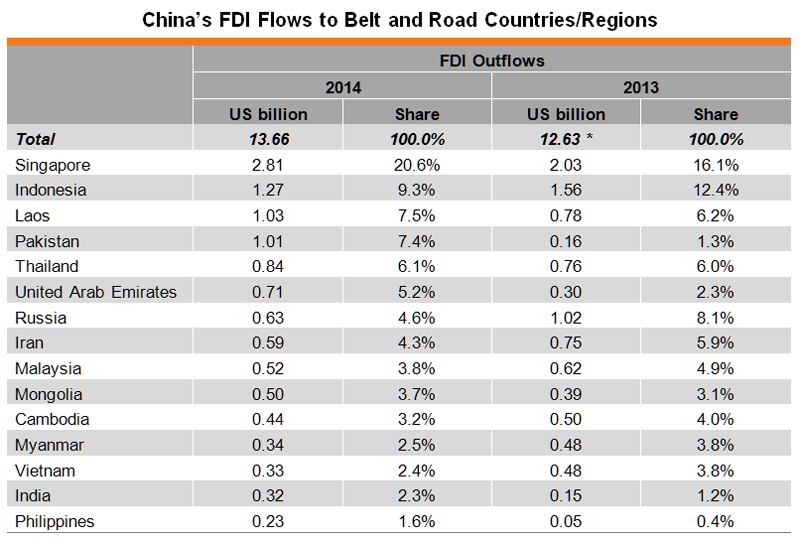


China’s implementation of the Belt and Road strategy is expected to further boost outbound investment by many mainland enterprises in the countries along the Belt and Road. China has also indicated that it will adopt a more proactive opening up strategy, giving full scope to the comparative advantages of different regions, including the Pearl River Delta (PRD), the Yangtze River Delta (YRD) and the Bohai Rim area. All such regions will be granted a greater degree of economic openness as well as enhanced economic strength in order to promote the building of the Belt and Road and comprehensively raise the level of China’s open economy. China's outbound investment, including that destined for countries along the Belt and Road, is expected to further expand in the future in line with this scenario. In line with the Vision and Actions agenda, the major investment projects in the countries along the Belt and Road are likely to focus on the following areas:
-
Infrastructure construction, including facilities relating to roads, shipping, aviation, energy and communications.
-
Agriculture, forestry, animal husbandry and fisheries, including the production and processing of related products.
-
Oil, gas, energy and metal ores, including co-operation in exploring and developing traditional and new energy resources.
-
Emerging industries, such as new-generation information technology, biotechnology and new materials.
-
Co-operation in science and technology, including establishing joint laboratories and carrying out technology transfers and maritime co-operation.


Opportunities for Hong Kong Companies
Over the years, service practitioners in Hong Kong have helped countless mainland enterprises handle their trading and investment businesses both in Hong Kong and in many overseas markets. With its inherent advantages when it comes to supporting mainland enterprises in their overseas investments, such as its free flow of capital, abundant international information resources and world-class professional services, Hong Kong is the preferred services platform for many mainland enterprises when they look to undertaking overseas ventures. Its professional services cover all aspects of such endeavours, including finance, law, tax, the risk assessment of sustainable operations, and international testing and certification.
Hong Kong is the main channel for China’s FDI outflows. In 2014, the amount of China's outward FDI carried through Hong Kong amounted to US$70.9 billion - or 57.6% of the mainland's total outward FDI flow. In terms of cumulative investment up until the end of 2014, the total amount of outward FDI from the mainland carried via Hong Kong was US$509.9 billion, accounting for 57.8% of the total cumulative investment as at end-2014.
According to surveys undertaken by HKTDC Research in the PRD, the YRD and the Bohai Rim between 2013 and 2015, most local enterprises intend to adopt the "going out" development strategy, as well as "bringing in" the advantages of foreign partners in order to develop both their domestic and overseas markets. In order to facilitate this, mainland enterprises need the support of wide-ranging professional services.
It is worth noting that more than half of the enterprises surveyed express a keen interest in using Hong Kong to find the services they need or to help identify suitable overseas partners. Indeed, some 65% of the surveyed enterprises in the PRD, 56% in the YRD and 60% in the Bohai Rim rate Hong Kong as the preferred service platform for “going out”. As the mainland accelerates its pace of “going out” and “bringing in” and advances its Belt and Road initiative, more business opportunities will inevitably become available to service practitioners in Hong Kong.
[Remarks: For more information on China’s outward FDI and the details of the HKTDC research findings, please see the HKTDC research report: Outbound Investment of Chinese Enterprises: Hong Kong the First Port of Call for Professional Services]
[1] Source: World Investment Report 2015, UNCTAD
[2] Hong Kong is the leading destination for the mainland’s FDI outflow, as well as the largest source of FDI for the mainland.
[3] The 18th CPC Central Committee adopted at its Third Plenary Session on 12 November 2013 the "Decision of the CPC Central Committee on Major Issues Concerning Comprehensively Deepening Reforms".
[4] NDRC Decree No. 20: "Decision of NDRC on Amending the Relevant Clauses of the Administrative Measures for the Approval and Record-Filing of Outbound Investment Projects and Administrative Measures for the Approval and Record-Filing of Foreign Investment Projects". (27 December 2014)
| Content provided by |  |
Editor's picks
Trending articles
13 Nov 2015
The Age of the Renminbi is Just Beginning
By Lawrence J. Lau
The age of the Renminbi is just beginning. In order to understand the rise of the Renminbi, it is important to realise that the centre of gravity of the World economy, in terms of both GDP and international trade, has been gradually shifting from North America and Western Europe to East Asia, and within East Asia from Japan to China, over the past couple of decades. China has become the second largest economy by GDP as well as the second largest trading nation in the World. The Chinese economy has also been growing and continues to grow at much higher rates than North American and European economies and Japan. China, with a national saving rate in excess of 40%, is a potential large foreign direct and portfolio investor to the rest of the World.
Please click here for the full report.
Editor's picks
Trending articles
13 Nov 2015
Possible Enhancement of the World Trade and Investment Systems
By Lawrence J. Lau
Economic analysis tells us that voluntary free trade benefits both the exporting and the importing countries. It also tells us that direct investment, which is necessarily long-term in nature, and long-term portfolio investment benefit both the investor and the investee countries. So on this basis, both international trade and long-term cross-border investment should be encouraged and promoted. What new initiatives can be undertaken to enhance the growth of international trade and long-term cross-border investment, and in so doing enhance the growth of the world economy as a whole?
The United States, as the largest trading nation in the world, in terms of goods and services, and China, as the second largest trading nation in the world (the largest in terms of goods alone), can jointly provide leadership in global trade promotion initiatives. Similarly, the U.S. and China, as the two largest countries of origin as well as destination of foreign direct investment can also jointly provide leadership in facilitating cross-border direct investment.
Even though for the economy as a whole every trading country is supposed to have a net gain from international trade, trade does create both “winners” and “losers” inside every country. One vexing problem of long standing for governments worldwide is how to redistribute the gains from international trade among their citizens so that everyone, or almost everyone, receives a net benefit. Unless the “losers” can feel that they have also benefited from international trade, they will oppose the expansion of trade and further opening of the economy. This is a problem that we shall attempt to address in Sections 2 and 3.
The harmonisation of product standards is also a long-standing issue in international trade—if standards can become more harmonised, it will facilitate trade, reduce transaction costs and lower the prices of many imported goods. Another major issue is the redefinition of the rules of origin to take into account the fact that the same product is today processed at or includes components and parts from many different economies so that it cannot be properly considered to have originated solely from the location of the final assembly and packaging. There is a crying need for the revision and simplification of these rules and to base them on the relative value added of different economies to a finished product. The treatment of cyber trade is also becoming a hot issue as it has been increasing by leaps and bounds, both within as well as across economies.
The growing proliferation of free trade areas (FTAs) around the world also raises the concern that the world trade system may once again become fragmented. A mechanism for open accession by countries or regions which are not original signatories to specific free trade agreements will help to avoid the increasing fragmentation of the world trade system. There is also a need to facilitate long-term cross-border investment flows, especially considering the vast differences in saving rates and demographic conditions across different economies. Bilateral or multilateral investment treaties based on the principle of national treatment can be very useful in this regard.
Finally, it may be helpful to the reduction of global carbon emissions by imposing a global tax on imports that depend on the carbon content. The tax rate does not need to be high, but such a tax will send a signal that the entire world will be working together to prevent climate change. All of these issues will be discussed.
This is the time for developing innovative ideas! This is the time to consider the next generation of enhancement of the world trade and investment systems!
Please click here for the full report.
Editor's picks
Trending articles
18 Nov 2015
OTG China – Investing USD 1tn along ‘One Belt One Road’
By Standard Chartered Bank
Summary
The China-led OBOR initiative aims to boost trade and investment growth through better infrastructure connectivity across Asia, extending to the Middle East, Africa and Europe. Simply put, ‘One Belt’ is a modern-day Silk Road, and ‘One Road’ is the maritime equivalent. The OBOR initiative has the potential to channel China’s savings and construction expertise to other countries to resolve their infrastructure bottlenecks, while making more efficient use of China’s excess capacity.
We estimate that official financing for OBOR could potentially top USD 1tn in the next decade. Infrastructure investment entails long-term investment commitments with uncertain returns, and official involvement is indispensable. We expect the recently established Asian Infrastructure Investment Bank (AIIB), New Development Bank (NDB) and Silk Road Fund (SRF), together with China’s policy banks, to play a leading role in supporting infrastructure development at the early stage. The AIIB, in particular, could potentially spur investment by other development banks and ‘crowd in’ private investment.
Commercial banks with substantial footprints along the OBOR are likely to play an important role in amplifying the effects of official funding. China’s strategy needs to be aligned with those of the other OBOR countries. The initiative has raised concerns in both OBOR and non-OBOR countries about China’s political and economic agenda. China-led investment in strategic industries such as telecommunications and energy may raise fears about the country’s expanding influence. To be successful, China needs to improve strategy alignment with other countries, gain the support of local communities, and embrace market principles and transparency. Domestically, China needs to better coordinate the investment plans of local governments to prevent a new round of over-investment.
If implemented effectively, the initiative can boost growth, Renminbi use and commodity demand. The expected infrastructure investment boom will not only lift demand immediately, but also raise potential growth rates by building physical capital. China will also benefit through more effective use of its excess capacity. In particular, we estimate that official financial support for the OBOR initiative may increase demand for crude steel by 200 million tonnes (mt) in 10 years, or 20% of China’s annual production capacity. Commodity-intensive infrastructure investment will also support commodity demand and prices. The initiative may accelerate China’s shift from being the world’s biggest goods exporter to a major capital exporter, and expand the use of Renminbi in international trade, investment and financial transactions.
Please click here for the full report.
Editor's picks
Trending articles
18 Nov 2015
Special Report – Global Supply Chains: New Directions
By Standard Chartered Bank
Summary
Global supply chains (GSCs) have transformed trade and the world economy in the last 30 years. We argue they will continue to expand, though more slowly than before, and could significantly boost productivity. But patterns will likely change.
Robotics could challenge the low-wage model while 3D printing could bring a shift to customised products, made locally. Offsetting this, better communications such as mobile and the Internet of Things should boost GSCs in both manufacturing and services.
The centre of gravity of low-cost manufacturing looks set to trend west from coastal China, inland and to ASEAN, India and eventually Africa. Improving infrastructure and new trade pacts including the Trans-Pacific Partnership and China’s initiatives may be key drivers.
Services trade is likely to grow fast as digital technology advances. Also, horizontal supply chains – trade between countries at the same wage level, based on firm-level excellence or consumer choice – are likely to grow, and expand among emerging countries.
Please click here for the full report.
Editor's picks
Trending articles
18 Nov 2015
Special Report – ASEAN – Growth in the Fast Lane
By Standard Chartered Bank
Summary
ASEAN is a high-growth region. Since 1980, growth has averaged around 5.4%. This is well above the global growth rate of 3.4% over the same period. It is also faster than other regions – including Latin America, Sub-Saharan Africa and Middle East and North Africa – over the same period. During the 1980-2013 period, ASEAN growth outpaced global growth by 2ppt on average. As a result, the per-capita GDP gap between ASEAN and the world narrowed to 2.7x in 2013 from 6.0x in 1980. We believe more than half of ASEAN has the potential to increase potential growth to 7% or higher. Countries such as Myanmar, Laos and Cambodia are already growing at such fast rates. At 7% growth, an economy doubles in size every 10 years.
We see tremendous growth potential for the ASEAN consumer market by 2020, owing to rising urbanisation and income growth. The anticipated shift in labour structure and demographics should create significant new demand. It should also cause a shift in consumption patterns as ASEAN consumers allocate a larger share of spending to high-quality products and services. We believe demand in Indonesia, Vietnam and Myanmar will surge, given their relatively large populations and low penetration rates for consumer durables and services. There are also potential challenges. The region’s diversity suggests that companies looking to tap its strong growth potential will need to develop multi-pronged strategies to cater to different cultures and tastes. Furthermore, protectionist measures are possible in strategic industries in the absence of strong domestic players. Even so, we expect the ASEAN consumer market to offer strong growth and substantial opportunities by 2020.
ASEAN will benefit from the shift in investment from China as China loses cost competitiveness and its labour supply tightens. ASEAN also has a demographic edge. ASEAN’s median age was about 27 years as of 2013. This is much younger than China’s estimated 32 years. ASEAN will also continue to add to its labour force over the next few decades. Compared to 2010, ASEAN’s labour force is expected to grow by 70mn by 2030, while China’s labour force is expected to contract by almost 70mn (source: UN data).
ASEAN economies need infrastructure development to attract investment that is shifting from China, and to compete with neighbours such as India. ASEAN economies are relatively advanced in telecommunications and have good access to electricity. Improvements are needed in transport infrastructure. To date, the focus has been on developing national infrastructure, but seamless regional transport infrastructure across ASEAN is needed to more closely integrate the region in the longer term.
Please click here for the full report.
Editor's picks
Trending articles
18 Nov 2015
Special Report – PRD’s Pain, China and ASEAN’s Gain
By Standard Chartered Bank
Summary
Companies in the Pearl River Delta (PRD) – China’s leading manufacturing hub – still face plenty of challenges, according to our sixth annual survey of manufacturers in the region. A labour shortage persists, and wages are likely to rise 8.4% this year.
The PRD’s short-term pain is part of China’s longer-term pursuit of a more sustainable growth model, in our view. Rising wages reflect China’s improving productivity and the increasing complexity of the goods it produces as it moves up the value chain. Rising FDI flows into the services sector reflect this shift.
Investing more in automation and streamlining processes is the most common response to labour shortages and rising wages for PRD manufacturers. Among those planning to relocate factories, the preferred offshore destinations are Vietnam and Cambodia.
ASEAN – with its lower wages, abundant labour supply and rising household affluence – is well positioned to benefit from the PRD’s shift towards high-end manufacturing and services. Infrastructure development would allow it to become Asia’s next PRD, in our view.
Please click here for the full report.
Editor's picks
Trending articles
18 Nov 2015
OTG Indonesia – Reality Check
By Standard Chartered Bank
Summary
President Joko Widodo (Jokowi) appears to be struggling to deliver on his promises to the electorate. Some polls suggest the president’s popularity has waned since he assumed office in October 2014. The Jokowi administration is unlikely to meet many of its ambitious economic targets for 2015, including the 5.7% real GDP growth target and 30% increase in tax revenues from last year. We believe financial market players and investors should moderate their expectations of the Jokowi government.
We think an unfavourable global and domestic environment is making it difficult for the government to meet its targets. Weak commodity prices are hampering exports (almost 50% of which are commodity-based). FDI has slowed as a result of pressure on the Indonesian rupiah (IDR) on market concerns over the current account (C/A) deficit and risk of capital outflows when the US Fed starts hiking policy rates. Meanwhile, household consumption and investment slowed in Q1-2015, presumably due to Bank Indonesia‘s (BI’s) monetary tightening stance and slowing economic activity in commodity-producing provinces. Government spending on infrastructure, which was expected to propel real GDP growth this year, also slowed in Q1.
Factoring in recent developments in Indonesia’s economy and the global environment, we revise our real GDP growth forecasts to 4.9% (from 5.2%) for 2015 and 5.3% (from 5.5%) for 2016. We maintain our year-end headline inflation forecasts at 3.7% y/y for 2015 and 4.5% y/y for 2016, but adjust our annual average forecasts to 6.5% (from 6.0%) and 4.5% (from 5.0%). We maintain our call on the BI rate – a 25bps rate cut in Q2 (presumably in May) and 25bps hikes each in Q3 and Q4, to reach 7.75% by end-2015.
We maintain a Neutral outlook on IDR bonds. Although IDR bond valuations have turned somewhat attractive, we see scope for further improvement. The key near-term concerns are IDR weakness and slowing foreign demand for IDR bonds. Given renewed market expectations of further monetary easing, and its spill-over impact on the IDR, we revise higher our trajectory forecast for IDR bond yields.
We maintain our view of continued IDR weakness in the coming months. We keep our USD-IDR forecast at 13,700 by mid-2015 and 13,500 by end-2015. With both domestic and external market conditions favouring an acceleration in IDR weakness, we revise down our short-term FX weighting on the IDR to Underweight from Neutral.
Please click here for the full report.
Editor's picks
Trending articles
HKTDC Research | 19 Nov 2015
An Overview of Central Asian Markets on the Silk Road Economic Belt
Central Asian countries (CACs), consisting of Kazakhstan, Kyrgyzstan, Tajikistan, Turkmenistan and Uzbekistan, are not yet key export markets or investment destinations for Hong Kong companies, but they are playing an increasingly pivotal role in the China-Central Asia-West Asia Economic Corridor. This is very much integral to the Silk Road Economic Belt (SREB), which is aimed at deepening and expanding mutually beneficial cooperation in such areas as trade, investment, finance, transport and communication. The national development strategies of the five CACs all share common ground with the SREB or the land-based component of the Belt and Road Initiative (BRI) being driven by China. As a "super-connector", Hong Kong is ready to deliver game-changing solutions for the 60-plus countries along the Belt and Road, including China's immediate neighbours in Central Asia.
Central Asia : A Vibrant yet Challenging Region
Best known for its trans-Asian commerce, via the ancient Silk Road, harsh geography (a lack of ocean access, an arid or steppe climate and mountainous landscapes) and sparse population are common images of Central Asia. Thanks largely to the region's vast amounts of natural resources, which were underexploited during the Soviet era, the past decade's high commodity prices have boosted the performance of the Central Asian economy. Combined, the five CACs – namely Kazakhstan, Kyrgyzstan, Tajikistan, Turkmenistan and Uzbekistan – make Central Asia a US$339-billion, 68 million-strong economy, with varying levels of development and purchasing power.
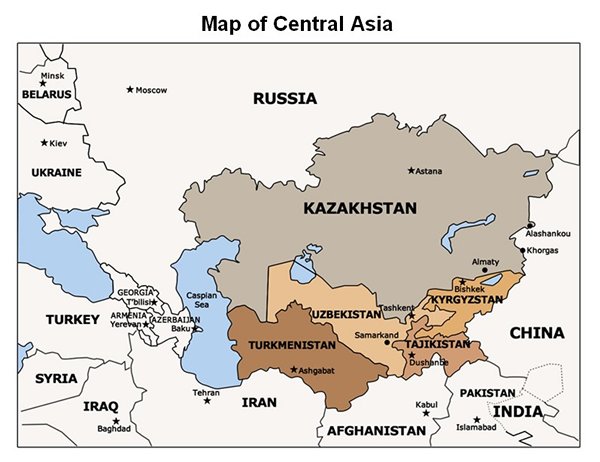
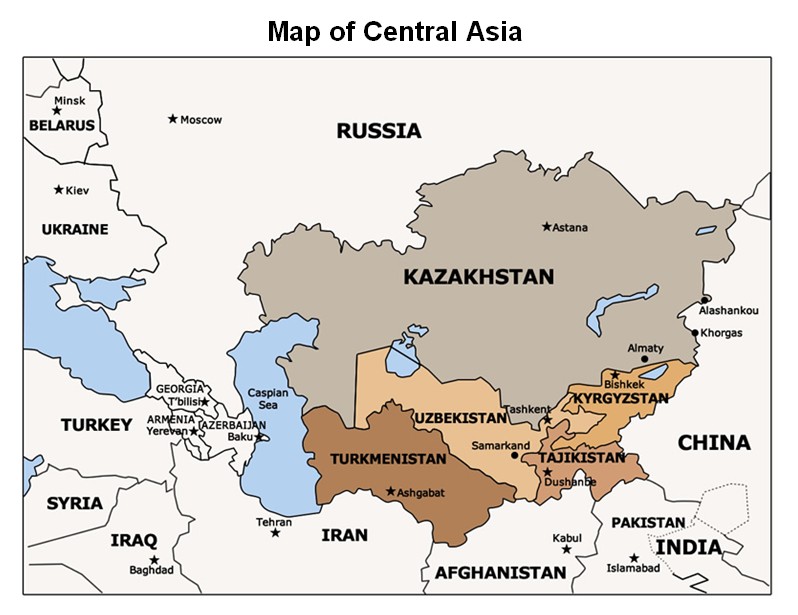
Benefiting from abundant mineral resources such as petroleum, natural gas, antimony, aluminium, gold, silver, coal and uranium, the energy sector has a key role to play in the economic development of the five CACs. Aside from having rich mineral deposits, the agricultural economy is also an important economic driver, with cotton, meat, tobacco, wool and grapes being major agricultural exports.
Given the abundance of rich and varied resources, economic growth in the five CACs has recently been curbed by nosediving oil and commodity prices. This, together with the spillover from sanctions applied by the West (the EU, the US, Canada, Australia and Norway) on Russia, continues to exert pressure on the overall GDP growth of Central Asia. Against this backdrop, the average growth in the five CACs is therefore estimated to slide from 6.6% in 2014 to 4.4% in 2015, before climbing back up to a brighter 5.3% in 2016.
Intra-regional trade in Central Asia has not been as significant as in Southeast Asia. For instance, in 2014, it only accounted for 7% of the total trade in Central Asia[1]. The relatively low dependency on regional trade, however, indicates a higher readiness to trade with partners further afield, including the CACs’ nearest neighbours, such as Russia and China. Moreover, the need for a more diversified economy, particularly in terms of manufacturing development, also indicates investment opportunities for Chinese companies.
While Central Asia is becoming an increasingly dynamic region connecting Eastern Europe and West Asia under the BRI, it can also be a challenging region for many new-to-the-market traders and investors. For instance, out of the five CACs, only Kyrgyzstan (since 20 December 1999) and Tajikistan (since 2 March 2013) are currently WTO members. Kazakhstan, whose accession is expected in early 2016, and Uzbekistan, are only observer states, while Turkmenistan has not even presented its candidature to the WTO.
Against this backdrop, customs clearance in Central Asia is often said to be overburdened, with bureaucratic obstacles leading to significant delays. Problems such as arbitrary seizures of goods, frequent changes in customs procedures without prior notification, excessive documentation and a lack of proper protocols to ensure that an appropriate appeals process is in place can make the importing process very uncertain, costly and time-consuming.
To a similar extent across all five CACs, business and cultural ties with Russia penetrate almost every area of daily and business life in the region. Not only do most people communicate with each other in Russian, they are also deeply accustomed to Russian culture, including movies and music. Russia also remains the most influential trading partner for most of the CACs, buying large amount of raw materials from and exporting a great deal of consumer and capital goods to all five countries.
The Customs Union, which became the Eurasian Economic Union (EAEU) from January 2015 and involves currently Kazakhstan, Russia, Belarus, Armenia and Kyrgyzstan, has further strengthened Russia’s influence in Central Asia’s trade development. While this has its advantages, it can also cast clouds, however. The recent recession in Russia and the sharp depreciation of the ruble have taken a toll on the Central Asian economy, imperiling the financial lifeblood of many Central Asian households and businesses.
Central Asia Under the Belt and Road Initiative
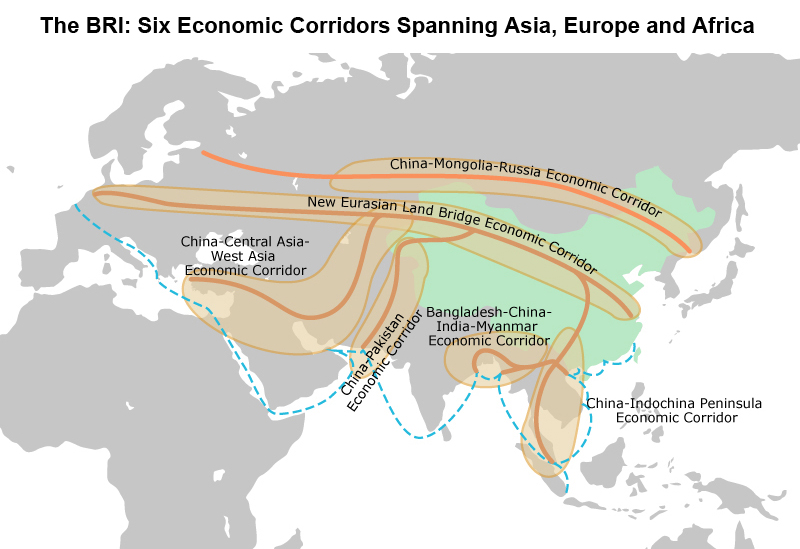
Central Asia has been crucial to the BRI ever since the Initiative was first suggested by President Xi Jinping in Kazakhstan in September 2013. In particular, the China-Central Asia-West Asia Economic Corridor, one of six economic corridors spanning Asia, Europe and Africa, runs from Xinjiang in China, then exits the country via Alashankou, joining the railway networks of Central Asia and West Asia before extending to the Persian Gulf, the Mediterranean coast and the Arabian Peninsula. The corridor covers all five CACs, as well as Iran and Turkey in West Asia.
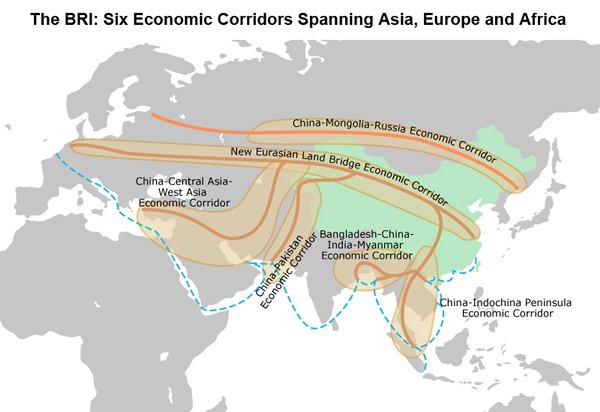
In conjunction with the BRI developments, the SinoKazakh Cooperation Centre is located right on the border between China and Kazakhstan, in Khorgas. China's youngest city, Khorgas was officially established on 26 June 2014, and attracted nearly two million traders, from both sides, in that year alone. China is also extending its wings to encompass many of the region’s infrastructure and logistics projects, including various oil and gas pipelines, dry ports and railway tunnels – including a 19-kilometre railway tunnel under the Kamchik Pass in double-landlocked Uzbekistan linking the country’s populous Ferghana Valley with other major cities such as the capital, Tashkent.
China has also signed bilateral agreements on the building of the SREB with Kazakhstan, Kyrgyzstan, Tajikistan and Uzbekistan, with a view to further deepening and expanding mutually beneficial cooperation in such areas as trade, investment, finance, transport and communication. The national development strategies of the five CACs – including Kazakhstan’s “Path to the Future”, Tajikistan’s “Energy, Transport and Food” (a three-pronged strategy aimed at revitalising the country), and Turkmenistan’s “Era of Might and Happiness” – all share common ground with the SREB’s objectives. Furthermore, at the third China-Central Asia Cooperation Forum held in Shandong, in June 2015, a commitment to “jointly building the Silk Road Economic Belt” was incorporated into a joint declaration signed by China and the five CACs.
Central Asia: A Trading Partner for Hong Kong and the Chinese Mainland
Investment, and therefore improvements in energy and transport infrastructure, under the BRI are expected to boost CACs’ trade, particularly with other Belt and Road economies such as Hong Kong and the Chinese mainland. The resultant trade facilitation will therefore allow CACs to better realise the advantages their resources give them and to increase and diversify their trade in terms of export/import destinations and product variety.
In terms of trade, Kazakhstan is the No.1 Central Asian trading partner of both Hong Kong and the mainland. In 2014, the country accounted for 57% of Hong Kong’s trade with Central Asia and 50% of the mainland’s trade with Central Asia. Also noteworthy is that all the five CACs are overwhelmingly export destinations, rather than sources of imports, for Hong Kong. The pattern is repeated for the mainland, except as regards Turkmenistan.
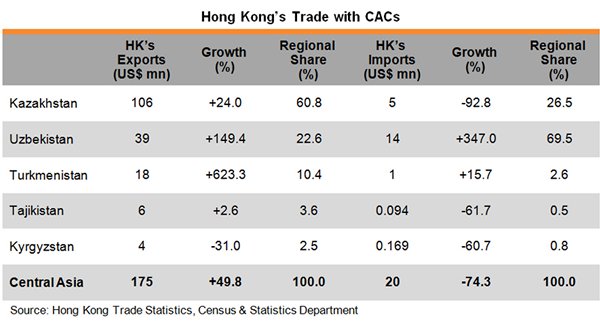
Product-wise, nearly 90% of Hong Kong’s exports and imports to and from Central Asia in 2014 involved electronics/electricals or related parts and components. A further breakdown shows that Hong Kong’s trade with Central Asia is predominantly concentrated on telephone sets, computers and related parts and components. This is largely due to the fact that more and more Chinese, Russian and even European telecommunications equipment companies have set up production facilities in Central Asia in order to take advantage of cheaper production costs and proximity to markets in Eastern Europe and West Asia, giving rise to a high demand for related inputs.
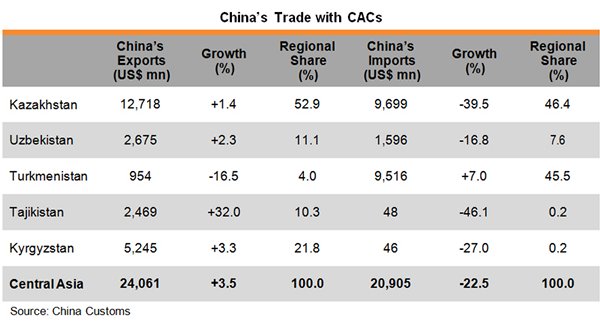
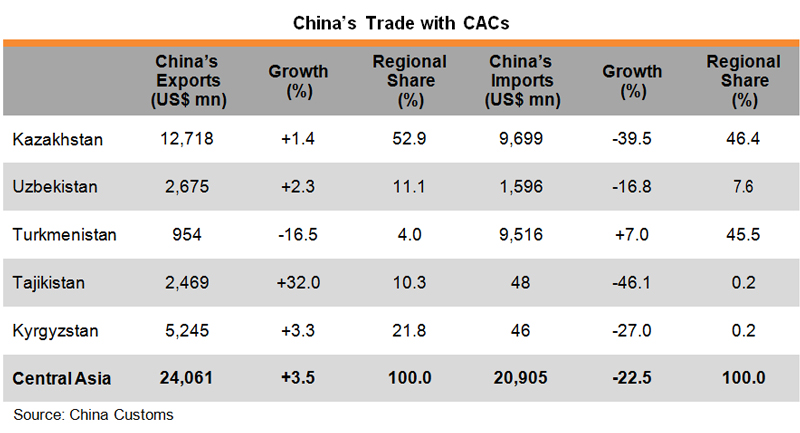
With respect to the mainland, the trade portfolio is much more diversified. Major exports to Central Asia in 2014 included apparel and clothing accessories (representing 22% of the total), electronics/electricals and related parts and components (21%), footwear (13%), vehicles other than railway or tramway rolling-stock, and parts and accessories (5%), and articles of iron or steel (5%). In the other direction, the mainland’s imports from Central Asia in 2014 were mainly energy resources and commodities, including mineral fuels (representing 71% of the total), chemicals and compounds of precious/rare-earth metals (9%), copper (6%), and ores, slag and ash (6%).
Central Asia: An Investment Destination for Hong Kong and the Chinese Mainland
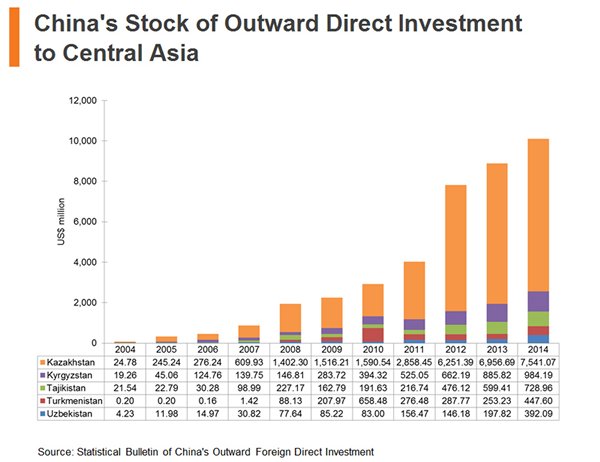
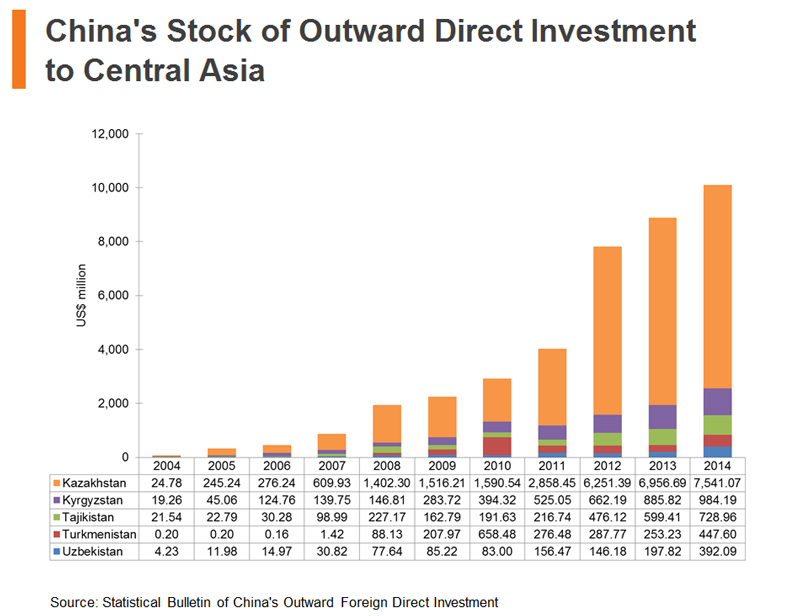
Prior to any increase in investment stemming from the implementation of the BRI, Kazakhstan is by far the largest recipient of outward direct investment (ODI) from the Chinese mainland, while no significant investment flows between Hong Kong and CACs have so far been tracked. In 2014, Kazakhstan accounted for 75% of the mainland’s ODI in Central Asia, followed by Kyrgyzstan (10%) and Tajikistan (7%). In terms of industrial distribution, oil, gas and metals receive the lion’s share of the mainland’s ODI in Central Asia, while infrastructure projects such as roads, railways and pipelines are also attracting investment.
To better encourage foreign investment, all CAC governments have committed to improving their respective business environments, but some have been more successful than others. For instance, the government in Kazakhstan has targeted a reduction in the time required to register a business from ten days to one hour, while the paperwork needed for customs procedures and other business operations is to be cut by 60%. The country has also extended and expanded its visa-free entry scheme for a number of countries in order to boost tourism and foreign investment. Furthermore, a US$3 billion stimulus package in 2015-17, part of the country’s latest five-year economic plan, is aimed at investment priorities such as the development of the transport and logistics sectors, and improvement works on utility networks and energy infrastructure, foreshadowing greater ease and better prospects of doing business.
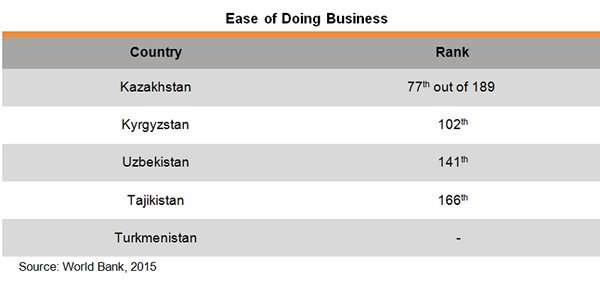
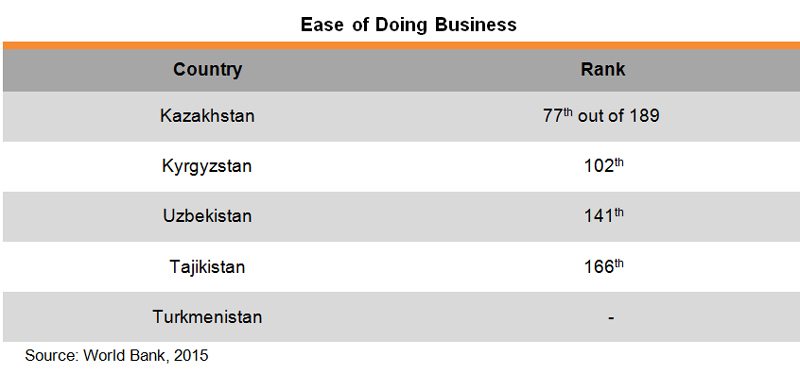
Tajikistan ranked low in terms of ease of doing business in 2015 but its array of business reforms include the implementation of new software at a one-stop shop for public service delivery and the further simplification of business registration procedures. These changes led it to rank as the top improver out of 189 economies surveyed.
Turkmenistan, however, does not even have an ease of doing business ranking for international investors to assess its business environment. This indicates that foreign investment is rare in the country but also that there is a clear lack of accurate and comprehensive information on different sectors. This makes market entry not only difficult, but also highly risky.
A Closer look at the Five “Stans”
As a regional giant, the size of the Kazakh economy is almost double that of the other four CACs combined. As a more advanced economy, Kazakhstan also leads in purchasing power, which was nearly 50% higher than the first runner-up, Turkmenistan, and 10 times bigger than the least-ranked, Tajikistan. As the region’s second most populous country, Kazakhstan’s average GDP growth rate between 2009 and 2014 was, however, only about half that of Turkmenistan (10.3%), and ahead of only Kyrgyzstan (3.6%) in the region.
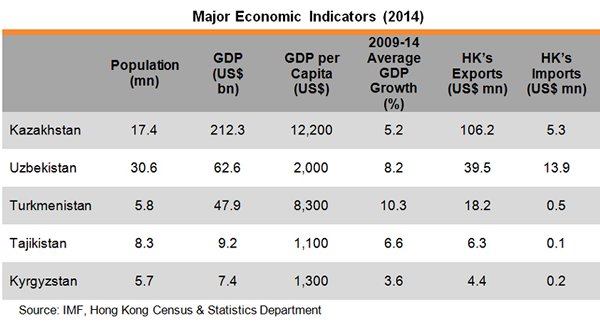
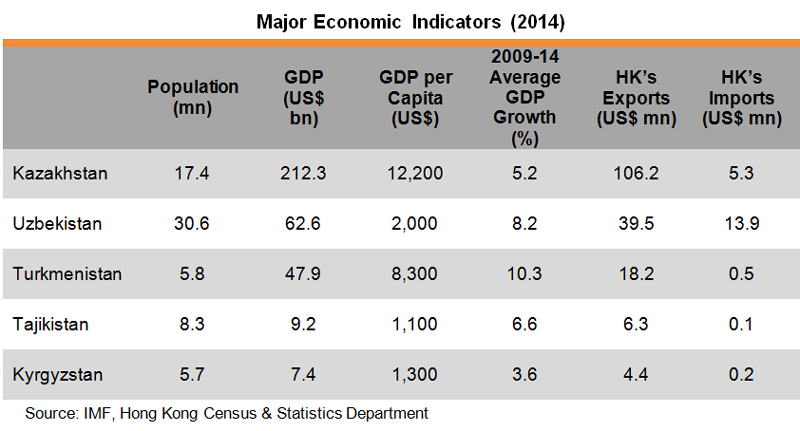
Thanks to its significant mineral reserves of oil, natural gas, coal, chrome, lead, tungsten, copper, zinc, iron and gold, Kazakhstan is an important world energy supplier. Processing of metals and steel production are also leading industries in the country. Combined with other smaller manufacturing sectors such as the production of machines, chemicals and food and beverages, industry accounts for about a third of GDP. The rest of the economy is mainly comprised of construction and agriculture, as well as an extensive but mostly small-scale service sector that includes wholesale/retail trade, real estate, finance and insurance.
As an important component in the BRI, Kazakhstan has been striving to upgrade and modernise its logistics and trade infrastructure. Aside from various oil-and-gas pipelines, the passages of the Yuxinou Railway linking Chongqing with Duisburg, Germany and the Chengdu-Europe Express Railway linking Chengdu and Lodz, Poland, the free trade zone developing on the border crossing at Khorgas, on the Kazakh-Chinese border, is expected to open huge prospects for transit of cargo through Kazakhstan.
Together with the Zhetygen-Khorgas and Jezkazgan-Beineu railway lines, the Western Europe-Western China motor road corridor, and the port of Aktau on the Caspian coast, this infrastructure represents a wide array of logistics and distribution options for traders across the region. Meanwhile, expected WTO membership in early 2016 will provide traders with further relief on customs duties and import barriers, making the country an even more attractive transit point for Asian/European-bound cargo and centre for regional distribution.
The economy of the region’s most populous country, Uzbekistan, meanwhile remains highly bound up with the growing and processing of cotton, fruits, vegetables and grain (wheat, rice and corn). Aside from being a world leader on reserves of gas, coal and uranium, Uzbekistan was also the sixth-largest producer and the fifth-largest exporter of cotton in the world in 2014. However, such industries as automotive (General Motors began production of Chevrolets in November 2008, for example), agricultural machinery manufacturing, biotechnology, pharmaceuticals and information technology have increased in importance over the years since independence in August 1991.
Following the signing of an agreement with China in June 2015 regarding the extension of economic cooperation under the framework of the BRI, bilateral cooperation in such sectors as business, transportation and telecommunication will increase between China and Uzbekistan, while bulk stock trading, infrastructure construction and industrial park projects will also be developed. The rapid development and extension of railway and road networks in Uzbekistan, including the 19-kilometre railway tunnel connecting the capital city, Tashkent, with the populous Ferghana Valley, is an early sign of success.
Blessed by large budget surpluses stemming from the exploitation of energy sources and commodities such as gas (abundant gas deposits lie underneath the Karakum Desert – including the Galkynysh gas field, which has the second-largest volume of gas in the world, after the South Pars field in the Persian Gulf), Turkmenistan has the worst record of economic and trade liberalisation among the former republics of the Soviet Union. Unlike countries such as Kazakhstan and Kyrgyzstan, which have rapidly reformed their economies in a more marketoriented direction, Turkmenistan has stuck to a “national way of development” and put less effort into modernising.
As a result, Turkmenistan’s participation in the world economy remains very low, even when compared to its Central Asian neighbours. Not only has Turkmenistan not presented its candidature to the WTO, it is also not a prospective AIIB founding member, the only exception among the five CACs.
In addition to various energy production sharing agreements (PSAs) with the Chinese mainland, Russia and Germany, the gas-rich country has announced plans to boost its gas output and is seeking ways to diversify its portfolio of export markets to encompass Belt and Road countries such as China and Iran, via new pipelines. In line with President Gurbandguly Berdymukhamedov’s leadership and declaration of an “Era of Might and Happiness”, the BRI is poised to give the country new incentives to reach out to other economies along the Belt and Road, including the Chinese mainland, notably in the transportation and infrastructure sectors.
Rich in antimony, aluminium, gold and silver and having substantial hydropower and agricultural (cotton and wheat) potential, Tajikistan is the poorest country in terms of per-capita GDP among the five CACs, thanks in part to its challenging geographic location – 90% of its territory is covered by mountains, with half being 3,000 metres above sea level. Its southern border with Afghanistan often adds uncertainty to the business environment as terrorism and drug trafficking are a menace. NATO’s withdrawal from Afghanistan last year poses a further threat to the country’s stability as the possibility of a spillover of unrest and terrorist activity from Afghanistan increases.
Close ties with Russia notwithstanding, Tajikistan’s trade with China has been increasingly vibrant in recent years, with Chinese enterprises staffing many infrastructure projects, including the Sahelistan Tunnel and Tajik-Uzbek Highway, as well as various resource extraction projects. Thanks to growing Chinese investments, the impoverished state broke its annual production record for cement and increased gold output by roughly 25 percent in 2014.
To revitalise the economy, the Tajik government has set three strategic goals in relation to energy independence, advancement in transport networks and food security. These national goals resemble most if not all of those of the BRI. In particular, more resources are expected to be pumped into the development of telecommunications, transportation and electricity networks. Meanwhile, better use of available infrastructure can make the nation attractive not only for businesspeople, but also leisure travellers. After all, thanks to its varied landscape and dramatic geographical features, Tajikistan was named No 2, behind Malta, in travel guide Globe Spots’ top-10 list of countries to travel to in 2014.
Heavily reliant on the production and export of gold, mercury, natural gas, uranium and agricultural products such as cotton, meat, tobacco, wool and grapes, Kyrgyzstan is a mountainous country with one-third of its population living below the poverty line. Due to its mountainous landscape, livestock farming has a prominent position in the country’s agricultural economy, which also boasts a vibrant food processing industry consisting of sub-sectors encompassing sugar, fruits, vegetables, meat, milk and oil.
Billed as the eastern door to Central Asia, Kyrgyzstan has been a WTO member since 1998. The relatively long tradition of adopting laws according to WTO regulations has helped Kyrgyzstan comply with international standards of trade and business. Furthermore, in May 2015 Kyrgyzstan signed a law ratifying treaties on the country’s accession to become the fifth member of the Kremlin-led Eurasian Economic Union (EAEU). It finally acceded in August 2015, and customs control at eight checkpoints along the Kyrgyz-Kazakh border have been abolished.
Jump-starting Trade and Investment with Central Asia
Situated in Central Asia, deep in the Eurasian continent, Kazakhstan occupies an area of some 2,724,900 km2. It is not only the biggest landlocked country and largest Central Asian economy in terms of geographical territory and GDP, but a good platform and partner for Hong Kong companies to tap into the Central Asian market under the umbrella of the BRI.
As a strategically important player under the BRI, Kazakhstan has signed a series of agreements (33 co-operation agreements worth US$23.6 billion in March 2015 and 25 agreements worth US$25 billion in September 2015) on closer cooperation in various sectors such as railway, electricity, nuclear energy and agriculture. Observing the growing impetus, many Chinese and other Asian companies (such as South Korean companies) have established operations in Kazakhstan.
The country, along with Kyrgyzstan, Tajikistan and Uzbekistan, is a founding member of the Asia Infrastructure Investment bank (AIIB), which is expected to play a pivotal role in supporting the development of infrastructure and other productive sectors, including energy and power, transportation and telecommunications, rural infrastructure and agriculture development, water supply and sanitation, environmental protection, urban development and logistics in the region.
In order to overcome volatility in global energy prices and create a stronger base for economic growth, President Nursultan Nazarbayev announced in November 2014 a new economic plan. "Path to the Future" puts infrastructure development top of the country’s list of priorities. Aside from sizeable infrastructural projects including road, rail and special economic zones, there will also be financial support worth KZT100 billion tenge (US$0.5 billion) for SMEs, creating some 4,500 additional jobs as well as incentives for Kazakh companies to internationalise.
For the time being, Kazakhstan is the only CAC with a consulate office in Hong Kong. This, together with reciprocal 14-day visa-free status for HKSAR and Kazakh passport holders, makes business connections between the two economies far easier than with other CACs. In addition, direct flights (twice a week on Tuesdays and Fridays) between Hong Kong and Almaty – the largest city in Kazakhstan and its key business city – give the country a further advantage over other CACs in terms of being Hong Kong’s first port of call in Central Asia.
Moreover, some Kazakh companies have chosen to list in Hong Kong. Kazakhmys PLC, a leading natural resource group and the first Kazakh company to list on the London Stock Exchange, listed in Hong Kong in 2011, while its marketing and logistics arm also relocated to Hong Kong from London in October 2012. The country’s imminent WTO membership in early 2016 is poised to trigger stronger trade and investment flows to and from Kazakhstan, and will provide a wealth of opportunities in international logistics and financial services for Hong Kong companies.
[1] Intra-regional trade share refers to the percentage of intra-regional trade to total trade of the region. A higher share indicates a higher degree of dependency on regional trade.
| Content provided by |  |
Editor's picks
Trending articles
23 Nov 2015
Down to Earth – Opportunities Offered by China’s One Belt One Road Strategy
Presented by Thomas Chan, China Business Centre, The Hong Kong Polytechnic University on 17 Oct 2015
This is a presentation for the Open Forum: Innovation and Entrepreneurship – Government Policy, Society & Technology co-organised by the University of Warwick, the Hong Kong Polytechnic University Manufacturing Alumni Association Limited and the City University of Hong Kong Engineering Doctorate Society.
Please click to download the presentation file.