









Content Group 4 of Thailand
Foreign Direct Investment
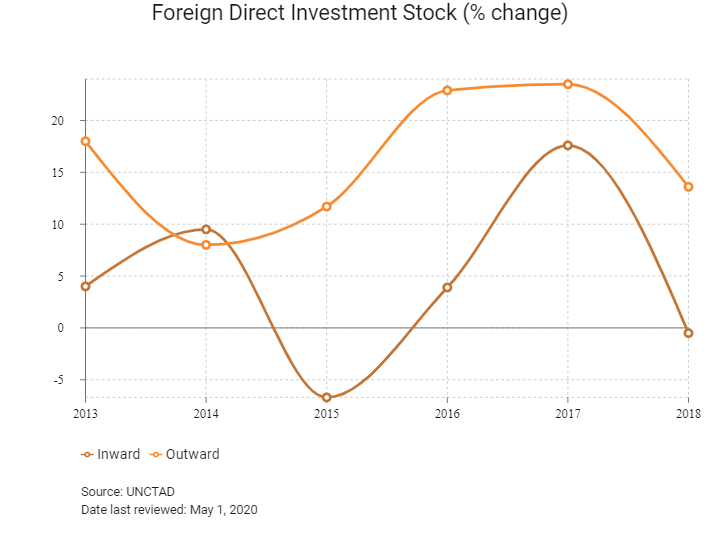
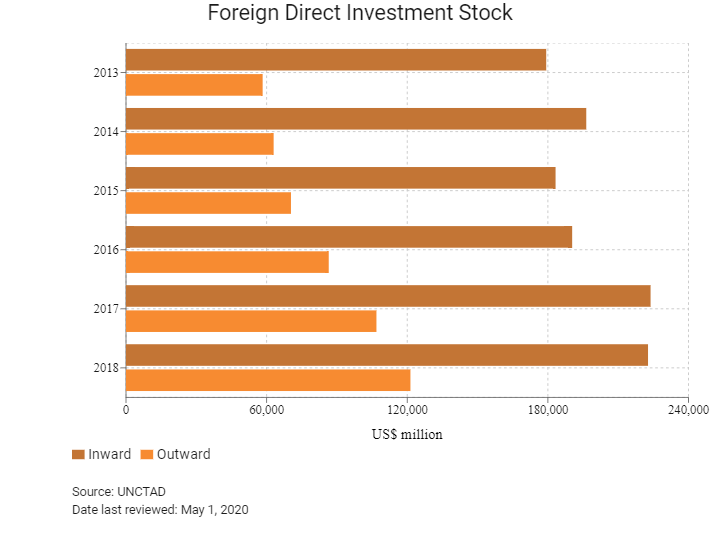
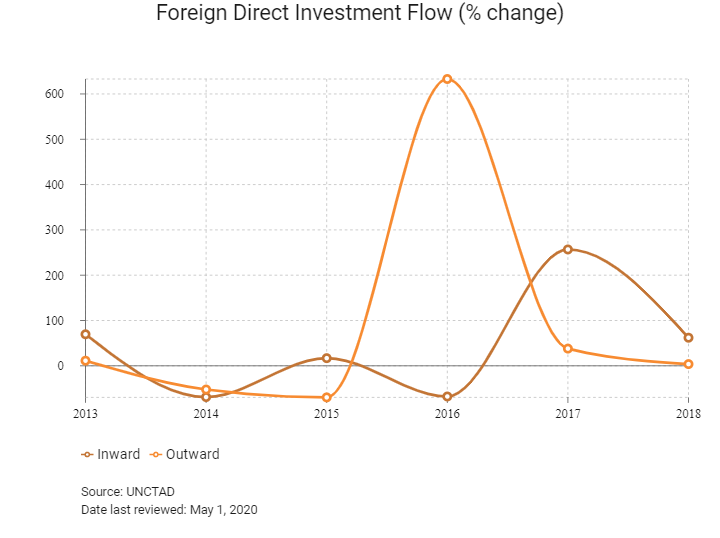
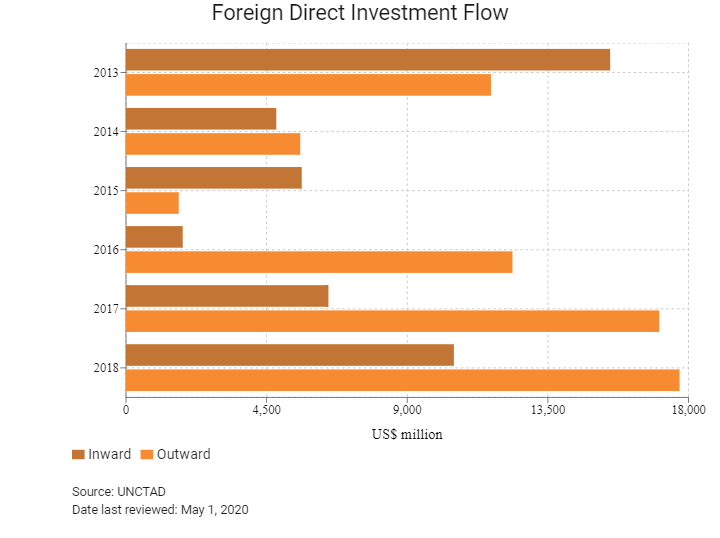
Foreign Direct Investment Policy
- The Thai business climate continues to be positive and welcoming to foreign investment, but local laws favour domestic companies in many aspects. All businesses operating in Thailand must register and obtain a foreign business licence from the Ministry of Commerce. Manufacturing firms must also register with the Ministry of Industry and the Ministry of Labour and Social Welfare. There is a risk that government spending could crowd out private and foreign investors.
- The Foreign Business Act (FBA) of 1999 is the primary piece of legislation with respect to foreign business activities. In spite of some reforms, company ownership restrictions remain in place and foreign nationals may own 49% of a company while it remains majority-Thai owned.
- Certain types of business activities are reserved for Thai nationals only according to the FBA. Generally, foreign investment in these areas cannot comprise more than 50% of share capital unless specifically permitted. Some exemptions can be obtained, such as permission from the director general of the Department of Business Development, with the approval of the Foreign Business Committee together with obtaining a foreign business licence.
- Foreign ownership of wireless or mobile telecommunications services; banking, accounting, bookkeeping and auditing services; tax consultancy; agriculture and forestry; transport; tourism capped at 49%; mining, oil and gas and waste management and water supply is capped at 75%.
- Under the Land Code, the Condominium Act and the Property Leasing Act, foreigners are not allowed to own land in Thailand – save for government industrial estates or Special Economic Zones (SEZs). In addition, a foreign investments in excess of THB40 million are entitles the investor to own 1,600sq m of land for residential use with the permission of the Ministry of Interior. Rather than purchasing, many foreign businesses instead sign long-term leases and then construct buildings on the leased land.
- Under the Condominium Act of 2008, foreign ownership in a condominium building cannot exceed 49%. Property can be expropriated under Thai law, but the risk of asset seizure is low.
- The Alien Employment Act prohibits foreign nationals from working in 39 occupations and professions including but not limited to labourer, goldsmith, farmer, accountant, auditor, engineer, architect, among others. Additionally, companies need to have certain minimum amount of fully paid up capital in order to qualify to employ specific numbers of foreign nationals in Thailand. Other conditions include having at least fifty local employees per expatriate.
- Businesses that are wholly foreign owned and incorporated in Thailand in terms of Thailand's Board of Investment are allowed to employ foreign nationals provided there is a 4:1 ratio of local to foreign nationals employed
- Thailand has a Seven-Year Investment Promotion Strategy (2015-2021) that aims to promote valuable investment in Thailand to overcome the middle-income trap and to achieve sustainable growth in accordance with the sufficiency economy philosophy. The six key investment promotion policies include support for the special economic zones, especially in border areas and those parts of southern Thailand in a way that will support efforts to enhance security in the area.
- On September 6, 2019, Thailand introduced a stimulus package called Thailand Plus that contains a wide variety of measures to attract foreign investment. The Thailand Plus package covers seven key points, such as the introduction of new tax incentives and deductions as well as reforms and initiatives designed to improve the ease of doing business in the country. The seven key points are tax incentives for investments; tax deductions for science, technology, engineering and mathematics development; deductions for investment in automation systems; amendments to the Foreign Business Act; establishment of an investment and steering committee; expanding free trade networks; and development of new special investment zones.
- Thailand is considering making online giants such as Amazon and Facebook collect value-added tax (VAT) on e-commerce sales.
Sources: WTO – Trade Policy Review, International Trade Administration, US Department of State, Thailand Board of Investment, UNCTAD, Fitch Solutions
Free Trade Zones and Investment Incentives
Free Trade Zone/Incentive Programme | Main Incentives Available |
Thailand's flagship investment zone is the Eastern Economic Corridor (EEC) built on the existing Eastern Seaboard industrial area. The EEC spans the provinces of Chachoengsao, Chonburi and Rayong, where Thailand's first industrial estates were developed. The Thai government wants to establish the EEC as the primary investment and infrastructure hub in ASEAN, serving as a gateway to East and South Asia. | - Investors will be able to secure a land lease of 50 years, with the option to renew for up to 49 years.
|
The Industrial Estate Authority of Thailand (IEAT) established 10 SEZs reserved for the location of 13 targeted industries to manufacture only in Thailand. These zones are located in Tak, Mukdahan, Sa Kaew, Trat, Songkhla, Chiang Rai, Nongkhai, Nakhon, Kanjanaburi and Narathiwas. In June 2019, the Thai government invited private sector companies to bid on the Port of Songkhla Improvement Project. | - SEZs are reserved for the location of industries manufacturing for export only, to which businesses may import raw materials and export finished products duty free (including VAT).
- Foreign ownership of land, foreign expert employment and permission to employ foreign unskilled labour. |
Thailand's Board Of Investment approved the Chana district of Songkhla province as the fourth model city, following the policy to promote investment under the Model City Project. |
-The investment incentives include an eight-year corporate tax exemption for new projects and a five-year exemption for existing projects, as well as other special privileges, such as a 90% reduction of normal import tax for a period of 10 years for raw materials or necessary materials needed for manufacturing products for the domestic market. |
Sources: US Department of State, Thailand Board of Investment, a Guide to Investment in the Special Economic Development Zones, Fitch Solutions